


Head of School September Update: What does it mean to be safe at school?
Head of School September Update: What does it mean to be safe at school?

Eliza McLaren
Head of School Update
September 2026
What does it mean to be safe at school?
Dear Wellington Community,
It’s been a joyful and inspiring start to the school year! As we settle into the year, I have been thinking about the questions that sit underneath the daily work of school: Who are we? What do we believe? How do those beliefs shape what we do for children each day? These are the questions that will organize my monthly letters this year.
This month’s question — What does it mean to be safe at school? — addresses the responsibility that comes before all the others.
The obvious answer is that children should be protected from harm. But safety is also what allows children to do the things learning requires — ask a question, make a mistake, attempt something difficult, or take a risk without fearing that failure will cost them their place in the community.
That does not mean school should be free of discomfort. School will sometimes be uncomfortable, because learning can be. Children encounter ideas they do not share, feedback they would rather not hear, problems they cannot immediately solve, and people whose experiences differ from their own. But safety is the confidence that difficulty, disagreement, and error can be navigated without humiliation or intimidation — safety means knowing that your dignity matters.
The Safety of Being Known
Wellington's founding story is usually told as one of entrepreneurship. Nearly fifty years ago, nine Columbus entrepreneurs imagined a coeducational independent school that would prepare students for a future they knew was changing rapidly. That instinct has defined Wellington ever since.
Our founding families shared another conviction. Wellington would bring together children from across Columbus, and each child would be “known and loved” for who they were. Founder Julie Wilkins has described this to me as the heart of Wellington: seeing each child's particular gifts, bringing out the best in them, and refusing to educate children as though they were standardized.
The founders understood that knowing a child and challenging a child are inseparable. For challenge to feel like belief rather than pressure, teachers have to see beyond “the athlete,” “the artist,” “the math student,” or “the quiet one.” Each child is more complicated, more interesting, and capable of more than any single category can capture. And a student who feels seen is more willing to take risks, whether that means asking the question, enrolling in the harder math section, auditioning for the musical, or asking for help. Feeling known allows children to stretch, struggle, and even fail without wondering whether those moments will change how they are seen or whether they still belong.
Feeling known and valued also means every student deserves to feel respected and secure at school when exercising our Wellington value of ‘be yourself.’ That commitment applies across differences in background, belief, identity, learning profile, and life experience. It also comes with expectations. We do not tolerate bullying, harassment, intimidation, or conduct that diminishes another person’s dignity. We expect students to encounter difference, navigate conflict, listen seriously, disagree respectfully, and understand that belonging carries obligations to others. These expectations are outlined in our School Handbook.
Being part of a community means taking responsibility for one another. That, too, is part of what it means to be safe at school.
The Safety That Comes From Connection and Contribution
Young people need to feel connected to a community and to know that they have something meaningful to contribute to it. A child should be able to say both, “People are glad I’m here” and “This place is better because I’m here.” The first creates connection and a sense of belonging. The second builds agency, responsibility, and purpose; it’s how children know they matter.
Our work is to help students recognize that they have something meaningful to contribute and then give them real opportunities to do so. Because this is central to how we educate, we take it seriously enough to measure. Several times each year, students complete surveys developed through the Wellington Initiative, a platform now used by schools across the country. We ask about engagement and about connection and contribution. We also ask whether students feel known, whether they have adults they can turn to, and whether they believe their presence and participation make a difference.
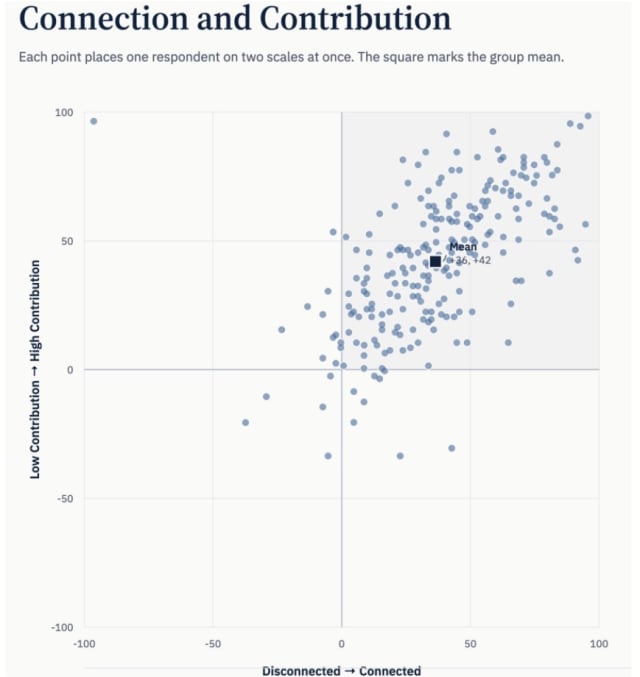
Wellington’s data from last year shows that most students reported feeling both connected to their community and able to contribute to it, which is encouraging. Just as important, the results help us see when a student may be having a different experience. A strong overall picture matters, but so does every child within it. We review the results student by student. When a student tells us, through a survey, a conversation, or a change in behavior, that they do not feel connected, we follow up.
The Safety of Physical Security
Safety also means protecting students and employees from physical harm. Nothing I do as Head of School matters more than that protection. My own children come to Wellington each day, and I understand personally the trust families place in us.
When people hear "school safety," they often think first of drills, locked doors, cameras, emergency plans, student supervision, and security personnel. We invest significantly in all of these, test them, and improve them. Hardware and procedures work best inside a culture where people pay attention to one another. I began this letter where I did because the safest schools are communities where adults know students well, students look out for one another, and concerns surface early because people trust one another enough to speak up.
Our physical measures exist to fortify that culture. Wellington partners with school-security professionals to audit, assess, and strengthen our practices; we partner further with the Ohio School Safety Center and Ohio Department of Public Safety for additional comprehensive reviews. Officer Don Stanko serves as our full-time Director of Safety and Security, Officer Brandon Rees serves as our full-time school resource officer through the Upper Arlington Police Division, and Officer E.J. Windham serves as a part-time presence on campus. Over the last year, we have added impact-resistant window film, campuswide emergency alert and communication systems, and technology that speeds communication, alongside extensive camera coverage with technology-assisted threat detection.
School safety depends on layers and systems: thoughtful facilities and technology, trained people, strong partnerships, clear procedures, attentive supervision, and a culture in which students are known and community members look out for one another. We continually evaluate each of those layers and invest wherever doing so can make Wellington safer.
Every employee undergoes a background check, and we maintain screening requirements for others who may have access to students or campus facilities. Our nurses manage medical needs, medications, injuries, allergies, and health protocols. Counselors and student-support professionals help students navigate social, emotional, and mental-health challenges.
This year, construction adds another layer of complexity. Secure boundaries separate school operations from construction activity, so students cannot enter work zones and construction personnel cannot enter spaces where school is in session. We continue to monitor and adjust these procedures throughout the project.
For a more detailed look at our safety work, including emergency communications, partnerships with public-safety agencies, daily procedures, and security expectations, I encourage you to read our full 2026–27 Security Overview.
The Safety of Relationships
Our most important safety measure is knowing our students. An advisor notices a student withdrawing, a teacher sees a change in behavior, a coach recognizes when confidence has given way to struggle, a friend speaks up when something feels wrong, or a parent and teacher touch base to make sure they’re seeing the same thing. Relationships are often our earliest warning system and our strongest protective factor.
Those same relationships also give children the confidence to take risks, recover from setbacks, ask for help, and try something new. A safe school is one where students trust the people around them enough to stretch beyond what they already know they can do.
Most of this letter describes how the adults at Wellington create a safe environment for students. We also teach students practical strategies for looking after themselves and one another. Through the curriculum, they learn to make healthy decisions, manage stress, respond in an emergency, and navigate relationships safely, both in person and online. They practice recognizing pressure, setting and respecting boundaries, and knowing when and how to ask for help for themselves or a friend. We approach safety drills in ways that are appropriate for students’ ages and developmental stages. In deciding how to conduct them and talk with students about them, we consider research on both the benefits of different approaches and their potential effects on students’ well-being. Above all, we want students to know they can come to a trusted adult when something feels wrong, even if they have made a mistake.
Next month's question: What does it mean to be educated for tomorrow's world?
Thank you for all you do for Wellington, and especially for helping us make our school a place where children are known, loved, and safe.
Go, Jags!
Eliza McLaren
Head of School
- Head of School


