Andres Marquez-Lara '00
Founder & CEO, UFacilitate • Valle de Bravo, Mexico
Your journey from Wellington to UFacilitate is anything but a straight line. Where did it begin?
The poet Antonio Machado said it best: “Caminante, no hay camino, se hace camino al andar.” Walker, there is no path. The path is made by walking. That captures my entrepreneurial journey better than any business plan ever could. My north star has always been intuition, and the synchronicities along the way that helped me confirm which direction to walk.
After Wellington, I studied psychology at Duke. Then, feeling pulled between my Venezuelan and American identities, I moved to Venezuela to reconnect with my roots. I ended up studying clinical community psychology there, and that's where I finally understood why Mrs. Robbins' drama class had been so profound for me. Through psychodrama, I discovered the power of performance and improvisation to help people develop, grow, and show up more fully as themselves. A thread that runs from a drama class in Columbus, Ohio, all the way to a facilitation network in 40 countries.
Back in the US, I worked in the public mental health system. But something kept pulling me toward creating, not just treating. After three years performing with an improv group, I launched my first company, Promethean Community, with the mission of strengthening communities through performance. It was a side hustle at first. Then, in May 2014, I made the leap to full-time. At my goodbye party — mid-panic — I got a call from Ashoka telling me I'd been selected for one of their prestigious emerging leaders bootcamps. I took that as a sign.
Over the next five years, I built a successful solo consulting practice, working with clients such as the Inter-American Development Bank and the Gates Foundation. Then, in the summer of 2019, I applied for a job in Austria. I didn't get it — but as a finalist, I started asking a different question: what if, instead of me facilitating, I coached others to do it? And just like that, UFacilitate was born. I didn't get the job, but I got something better.
You're often described as the founder of UFacilitate, but your most meaningful story — the Panama workshop — predates it. Can you tell that story?
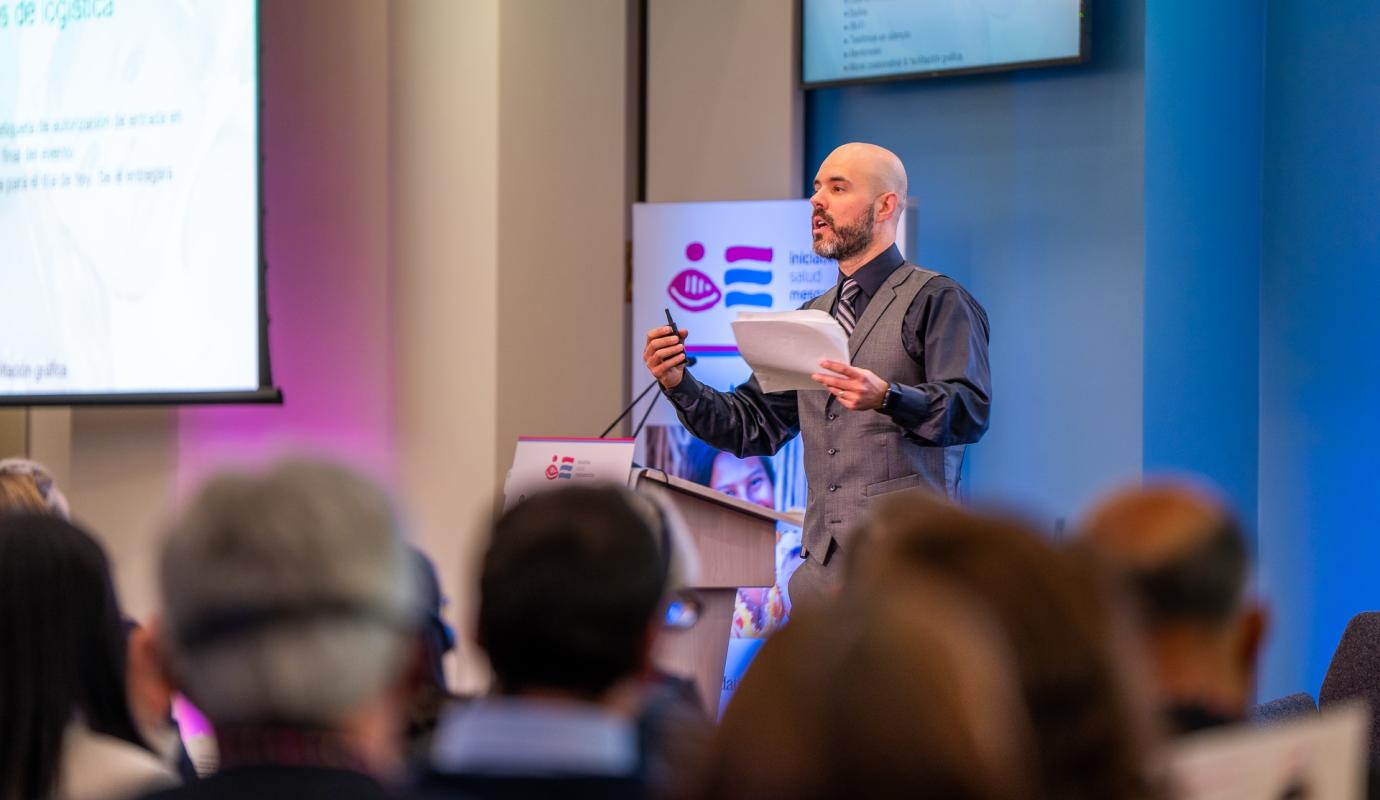
Yes, and the distinction matters to me. The Panama workshop happened in 2018, under my earlier work with Promethean Community — not UFacilitate. I was facilitating for Salud Mesoamérica, a ten-year initiative organized by the Inter-American Development Bank to save the lives of women and children across Latin America. I introduced a facilitation framework called the Ecocycle, which mirrors nature by helping teams think through what is gestating, being born, maturing, and what needs to be released. It struck a chord. Teams began using it across the initiative, training health care systems in eight countries to think through the life cycle of their programs.
Then, in February 2025, I was asked to facilitate the closing ceremony of that ten-year initiative in Washington, D.C. During the opening remarks, Dr. Emma Iriarte — the woman who had led this work for a decade and a dear friend and mentor — spoke about the Ecocycle. One framework from one workshop had rippled into a project that touched the lives of three million women and children. Moments like that remind me why the how we come together matters as much as the what we are trying to accomplish.
You're also a Professor of Practice. How does teaching intersect with your entrepreneurial work?
A Professor of Practice is someone who brings real-world knowledge directly into the classroom rather than researching from a distance. For over a decade, I've taught leadership development in executive education programs at Georgetown University and George Washington University's Center for Excellence in Public Leadership. What I love about teaching mid- and senior-level leaders is that they bring live, complex challenges into the room. Someone is dealing with a trust breakdown on their leadership team, or a merger that's fracturing their culture, or a remote team that has drifted apart. There is no hypothetical case study.
Teaching also makes me a better facilitator. The classroom is itself a laboratory for what UFacilitate does in the field: creating conditions where people can think more clearly, feel more connected, and lead more humanely. Both roles keep reminding me that leadership is not a set of skills to master. It's a practice of becoming.
What does Wellington mean to you, looking back?
It all started in Mrs. Robbins' drama class. That experience set me on a path I'm still walking. But beyond that class, Wellington felt like family — and as a Venezuelan American kid in 1990s Columbus, that sense of belonging mattered more than I could articulate at the time. Because it was small — my graduating class had fewer than 50 people — I could participate in everything: sports, theater, choir, AP classes. I could be intellectually curious and artistically alive at the same time, often alongside the same friends. Those interests have never gone away.
What I've come to understand, looking back, is that Wellington gave me something deeper than extracurriculars. It gave me a model of what a community can feel like when it actually works. To this day, my closest friends are people I met at Wellington. That extended family has followed me through every chapter of my life, and that's rare.
What are you working on now, and what's on the horizon?
Three things, each of them meaningful in different ways. UFacilitate just crossed 200 facilitators in over 40 countries, and 2025 was our best year yet. As the world grows more fractured and uncertain, the need for spaces where people can navigate the messy human stuff of working together only grows.
The Second Place Fund is a venture I recently co-founded to support women social innovators who reach the finalist stage of major prize competitions but aren't selected. These are extraordinary women doing systems-change work, and they lose momentum not because their ideas aren't worthy, but because the ecosystem isn't built to sustain them. We offer unrestricted funding, capacity building, wellness support, and connections. Our goal is to raise one million dollars this year to support 30 to 50 women entrepreneurs who were just shy of winning.
Subnets for Good is my attempt to build a bridge between the social impact sector and Bittensor, the world's largest open-source decentralized AI protocol. What excites me most is working with women who have graduated from coding bootcamps in the global south and onboarding them onto Bittensor — decreasing the digital divide while creating real income opportunities.
And my book, "Rituals 2.0: Pathways to Reconnection, Healing, and Hope in an Uncertain World," launched spring 2026. It grows out of something I've believed for a long time: that we are living through a moment of profound collective grief and transformation, and we desperately need new kinds of containers to hold it. Not ancient rituals necessarily, but modern ones — workshops, gatherings, games, nature-based experiences — that create the conditions for us to feel what we're going through together.
The through line across all of it is the same question Mrs. Robbins' drama class first raised in me: how do we create spaces where people can show up as they truly are, and feel a little less alone in the becoming?
What advice would you give Wellington students considering entrepreneurship?
The best advice I ever received came from a mentor just as I was launching my first venture: "Try it out and see what emerges." So much of what holds us back is fear — fear of failing, fear of getting it wrong, fear of not being ready. But readiness is a myth. You build the path by walking it.
Over the past 15 years, I've developed a practice. Pause and make space before any major step — the answers rarely come when you're rushing. Listen to your intuition; it almost always speaks through the body first. Take a small step in the direction it points — you don't need certainty, you need small, imperfect moves. Watch for synchronicity — when you're walking your path, the world tends to confirm it in unexpected ways. Then repeat. None of what I've built was planned in advance. There is no manual for the life you're meant to live. But there is a wisdom in you that has clues. Follow them.