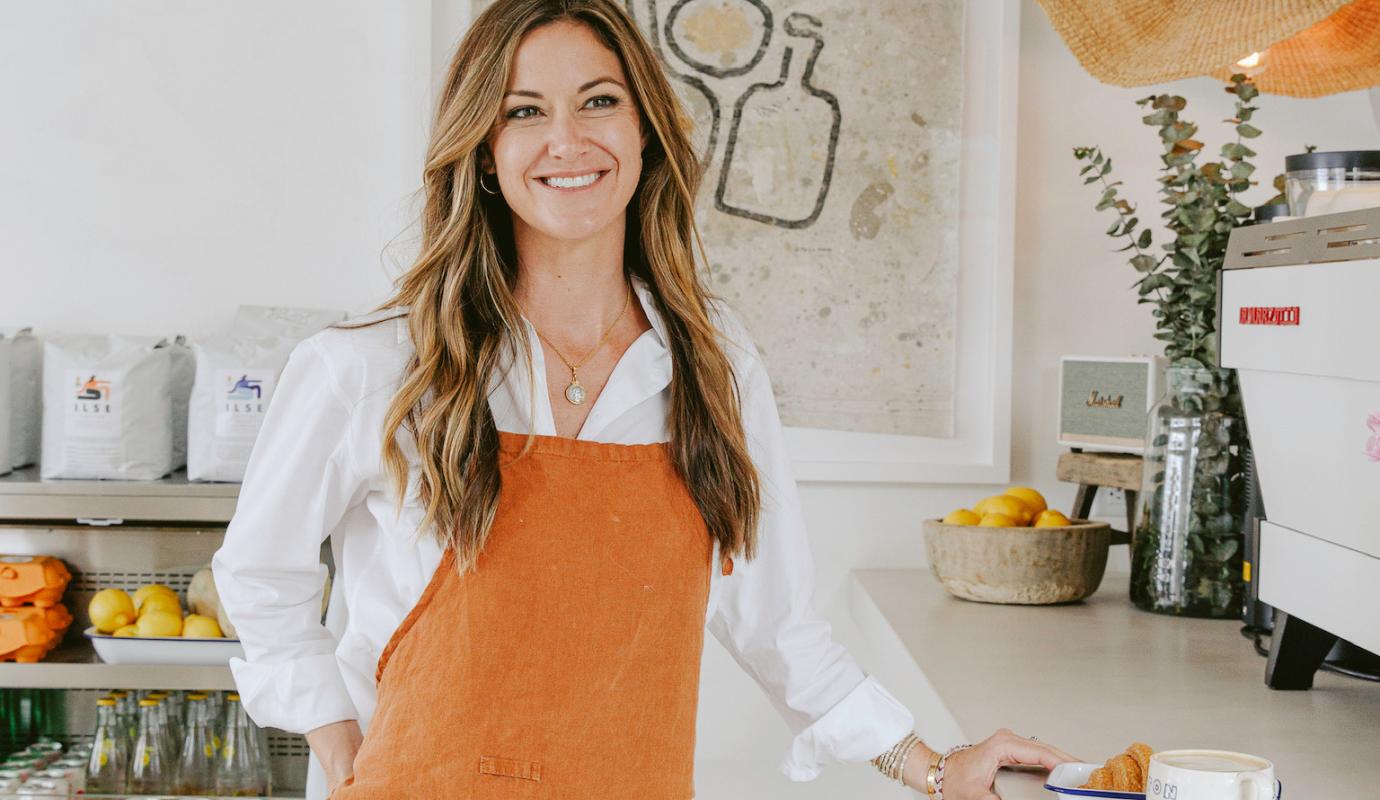
Jill Lukeman ’06
Co-Founder, Arden’s Rowayton & The Mariner & The Muse • Westport, CT
Before Arden’s and The Mariner & The Muse, you had a career in tech at Google, Snap, and Airbnb. What did those years teach you about building something of your own?
I feel incredibly fortunate to have spent formative years inside those organizations. Being there gave me a front-row seat to bold ideas becoming reality — watching creative thinkers shape culture, products, and experiences at scale. What stayed with me most wasn’t the innovation itself. It was how those companies built people.
The best leaders I worked with weren’t just building businesses. They were building confidence, autonomy, and growth in the people around them. That deeply shaped how I think about leading my own teams. Hospitality is notorious for low employee retention, but I’ve never accepted that as inevitable. At Arden’s and The Mariner & the Muse, we’ve built environments where people have real ownership, room to experiment, and permission to contribute ideas. I’m proud that many of our team members have stayed with us for years. That culture of empowerment is something I consciously carried from tech into hospitality.
The other thing those years gave me was a genuine comfort with experimentation and failure. You try, you learn, you iterate. That mindset gave me the courage to leave a stable career and build something of my own — and to keep evolving it without waiting for everything to feel perfect.
How did Arden’s come to exist, and how did The Mariner & The Muse follow?
I’ve had an entrepreneurial itch for as long as I can remember. In middle school at Wellington, I came up with the idea for “Single’s Bread”: a half-loaf for single people. I imagined two shoppers reaching for it in a grocery aisle and having that “you too?” moment. I think even then I was drawn to the idea that businesses could create connections.
I went on to build a career in tech — roles I genuinely loved — but I always felt a pull toward building something of my own. When I moved from New York City to Connecticut, I deeply missed the sense of community I’d had in the city — and, honestly, really good coffee. During COVID especially, that absence felt amplified. Arden’s was born from that longing: a place where people could gather, linger, feel known. It was less about opening a café and more about creating a daily ritual space for the town.
The Mariner & The Muse emerged from the same project. Designing Arden’s became one of the most rewarding parts of building it. I found myself sourcing vintage pieces, layering textures, thinking deeply about how space shapes emotion. At the same time, I was working on my own historic home and falling in love with older pieces that carry story and patina. The Mariner & The Muse grew out of that exploration. Today the two ventures feel distinct but deeply connected. Arden’s is about gathering around the table. The Mariner & The Muse is about the spaces we return to after.
What have been the most meaningful moments since opening?
Building something that truly resonates with the community — and feeling that tangible feedback loop from the very first day — has been incredibly rewarding, and it genuinely hasn’t gotten old.
Opening day stands out so vividly. So many of my family and friends were there. My boys were just a few months old and two years old at the time. Having them there alongside my best friend from Wellington felt like a full-circle moment — a convergence of chapters: who I was as a kid with big ideas, who I’d become professionally, and who I was becoming as a mother and founder all at once.
Another defining moment was launching our After Hours dinner series. It had lived in my head for so long — the idea of transforming the space at night, candles glowing, long tables, conversation stretching late. When we finally brought it to life and the room filled with people, it felt surreal. I’ve always believed that people are the color in the room, the energy that animates a space. Seeing that vision come alive was deeply affirming.
I’m also genuinely proud of our team. Hospitality is notorious for turnover, but we’ve had unusually high retention. Watching people grow, build relationships with regulars, and feel ownership over the space has taught me so much about leadership and community-building. That human part has been one of the most meaningful aspects of all.
How do you describe your design philosophy?
I think of it as contextual hospitality and design: the belief that places should be deeply shaped by where they are located, the stories already embedded in their walls, and the people who move through them. The goal is never to replicate a look or follow a trend, but to create something that couldn’t exist anywhere else — because it’s shaped by that exact setting.
I want guests to feel like the space could only exist here, that it belongs to this town, and in some small way, to them. Ultimately, I believe great spaces don’t just look beautiful. They hold memory. They tell stories. And when designed thoughtfully, they invite people to become part of that story themselves.
What does a typical day look like for you?
I wear a lot of hats, but the most important one is mom. That role grounds everything else. Most mornings start early with my four- and six-year-old sons. Once they’re off to school, I shift into work mode.
My biggest fear in life is boredom, so building two businesses has certainly solved that. What it’s also required — and this doesn’t come naturally to me — is structure. When you’re not reporting to anyone, you have to build your own accountability. I’ve had to learn to block my time in focused sections and be disciplined about where my energy goes. For Arden’s, I focus on finance, marketing, and strategy. For The Mariner & the Muse, it might mean meeting design clients, sourcing vintage pieces, or working through inventory. There's always a creative layer and an operational layer running simultaneously. Evenings are back to what matters most: my boys, our three animals, dinner together.
It’s full, sometimes messy, often energizing, and never boring. That’s exactly how I like it.
What's coming next?
With Arden’s approaching four years, I’m focused on consistency and longevity. We’re launching a catering arm and opening Bar Arden on weekend evenings — watching the space transform after hours has been creatively energizing. For The Mariner & The Muse, I’m most excited about growing our audience and taking on larger, more ambitious design projects.
And quietly in the background, we’re developing a second hospitality concept in Fairfield County. It's keeping me up at night in the best possible way. It’s still early, but dreaming about it feels like being back in that original spark phase again. That sense of possibility is what excites me most.
What would you tell Wellington students considering creative entrepreneurship?
I wish I’d recognized earlier that creativity doesn’t always look the way we expect it to. I didn’t grow up thinking of myself as a creative person. But looking back, I was constantly building ideas at Wellington — thinking about connection, conceptualizing businesses, noticing atmosphere and experience. The seeds were there long before I had the confidence to name them.
Entrepreneurship is far less about certainty than people think. You don’t wake up one day feeling fully qualified. You test ideas, put them into the world, see what resonates, and pivot when needed. If I could offer anything, it’s simply this: pay attention to what feels alive to you. That is often the beginning.