Every morning for two years, a group of Black mothers in Hillsboro, Ohio walked their children to the local school. Every morning, they were turned away. The school board had closed the doors to Black students even after the Supreme Court ruled segregation unconstitutional in Brown v. Board of Education.
Blinds were drawn so white students inside wouldn't see the Black families outside. People shouted slurs. Someone burned a cross on a family's lawn. The school board threatened arrests. But the mothers kept walking their kids to school, rain or shine, for two full years.
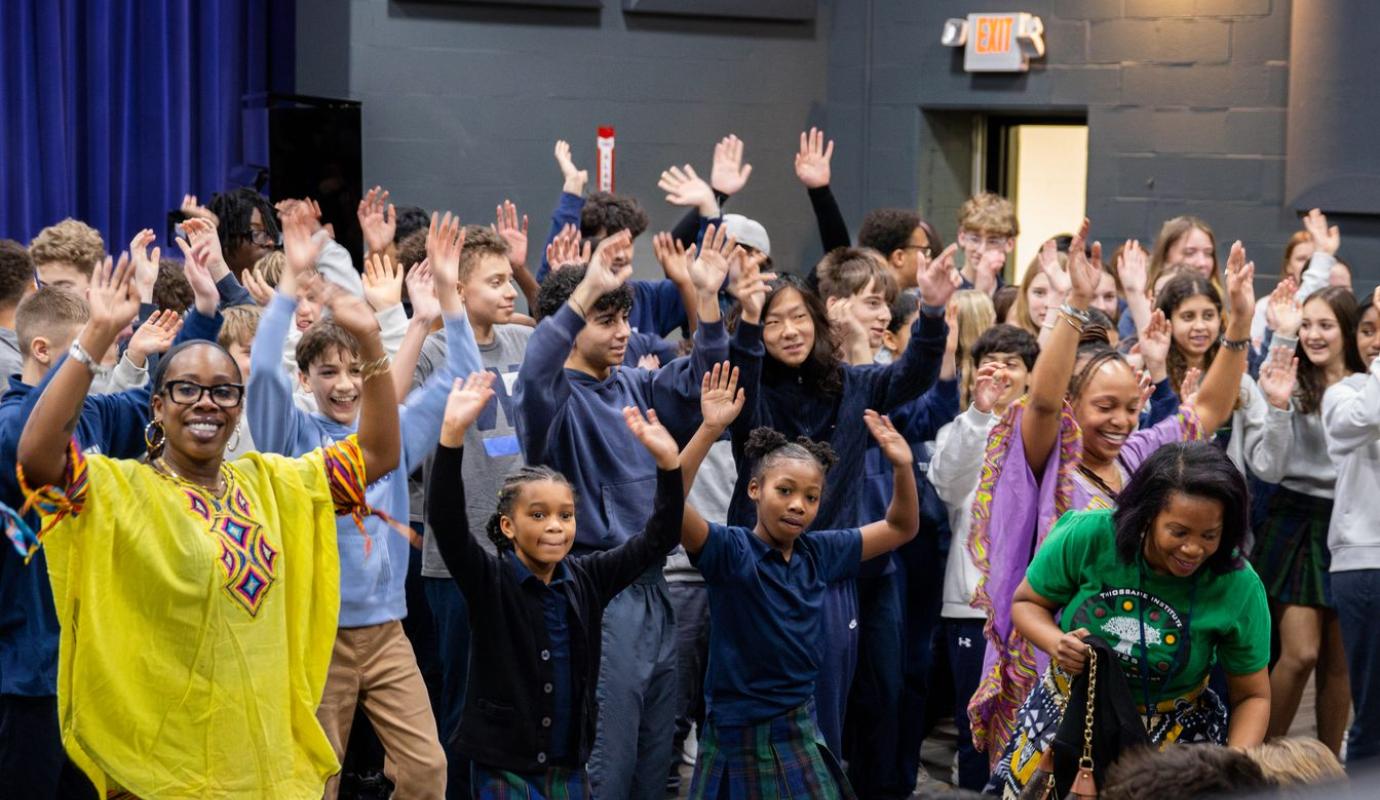
This week, Wellington students learned about these mothers during our Celebration of Black Voices. Dr. Carlotta Penn, who works in equity and global engagement at Ohio State and wrote a book about the Hillsboro story, spoke to middle and upper school students about what happened when a Supreme Court decision met real resistance in a small town.
The mothers weren't marching for a legal victory—they already had that. They were marching to make it mean something. Dr. Penn's talk reminded students that big changes rarely happen because of a single ruling or speech. They happen because ordinary people show up, repeatedly, even when it's hard.
Stations and Activities
Before the keynote, middle and upper school students rotated through different stations. At the Black history trivia session, they tested their knowledge of leaders and educators. In Writing for Wellness, inspired by writers like Octavia Butler and Toni Morrison, students worked on affirmations and thought about turning difficult emotions into creative work.
The Listening Lounge covered nearly a century of Black music, from Louis Armstrong and Billie Holiday to Kendrick Lamar and SZA. Students listened to protest songs like "Strange Fruit" and "A Change Is Gonna Come" and talked about how musicians have used their art to respond to injustice and build community.
The Amazing Race station looked at athletes—Simone Biles, Serena Williams, Jesse Owens, Jackie Robinson—and what it takes to compete at the highest level.
Our Youngest Learners
Early childhood and lower school classes explored Black leaders in ways that made sense for their ages. The youngest students connected Simone Biles with seven Olympic medals and Louis Armstrong with his trumpet. Prekindergarteners learned about Serena Williams' championships and George Washington Carver's experiments with peanuts.
Kindergarteners heard about Katherine Johnson's work on space missions and Maya Angelou's poetry. First and second graders learned about Ruby Bridges' first day at an all-white school, Madam C. J. Walker's business success, and musicians like Beyoncé and Alicia Keys.
Third and fourth graders studied Rosa Parks, Thurgood Marshall, Toni Morrison, Muhammad Ali, and Barack Obama. In art, music, and PE, teachers highlighted people like Lewis Latimer, Patricia Bath, Shirley Chisholm, Gordon Parks, Lizzo, Ayana Elizabeth Johnson, and Josephine Baker.
The goal across all grades was the same: help students see that Black history isn't one story. It's scientists and athletes, writers and inventors, people who changed things in different ways.
Making Connections to History
Learning history well means doing more than memorizing names and dates. It means asking questions about how change actually happens. It means trying to understand what people went through. And it means thinking about what you can do now.
The Hillsboro mothers walked their children to school every day for two years before the doors opened. That kind of persistence is worth remembering, especially when students are thinking about their own role in making things better.
At Wellington, this work doesn't stop when February ends. It continues in classrooms throughout the year.