By Oscar Humbert '26
Editor’s Note: Wellington alumni continue to amaze us with the many ways they shape their communities and industries. From entrepreneurs and innovators to educators and artists, they are charting bold paths forward while staying rooted in the values that connect them back to Wellington. Jags on the Roam celebrates these stories, offering a window into the impact our graduates are making in the world.
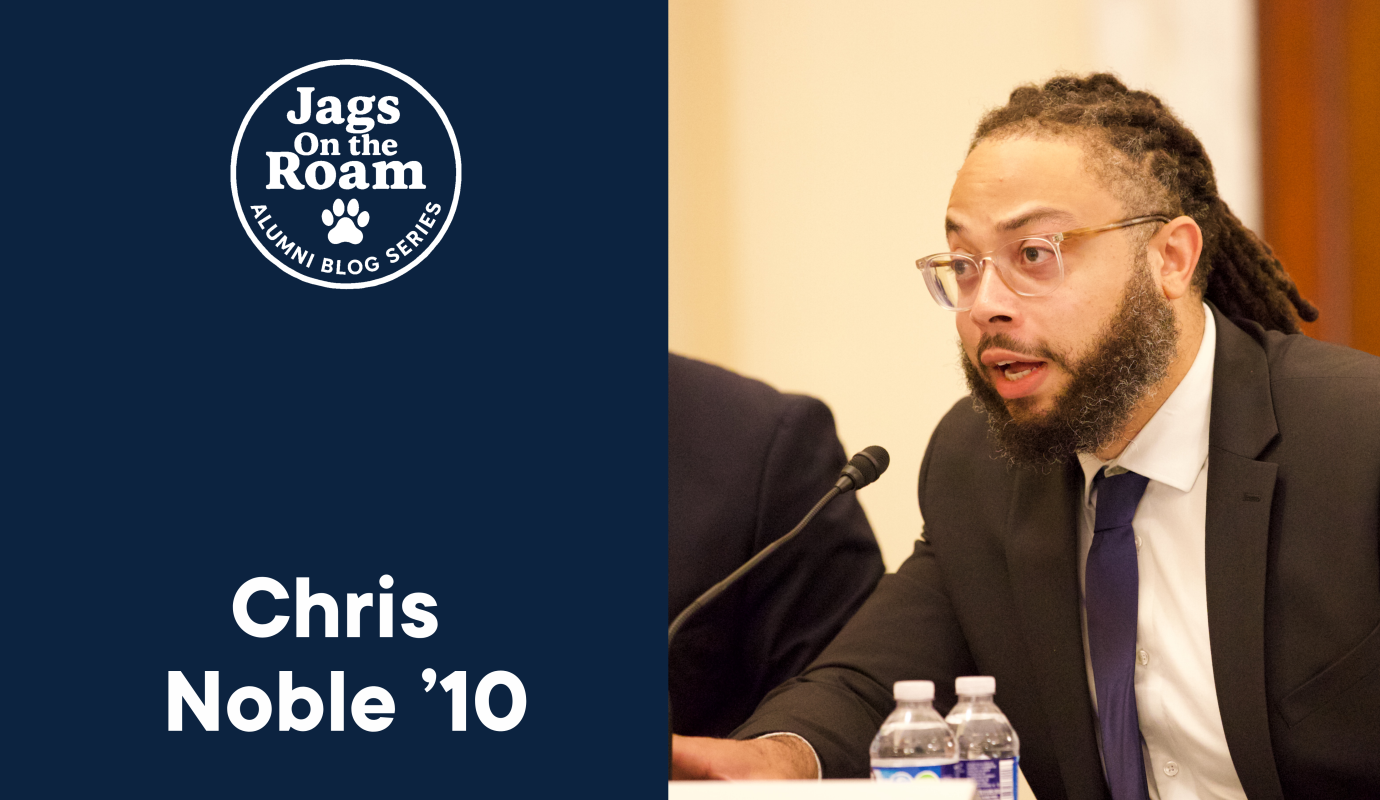
When Chris Noble graduated from Wellington in 2010, he did not have a perfectly mapped out career plan. In fact, he describes his professional journey as “non-linear” and even “meandering.” Looking back, though, that winding path is exactly what prepared him for the work he does today. Chris currently serves as the Policy Director for the Private Equity Stakeholder Project, a nonprofit focused on transparency and accountability in the private equity industry. His job is, in simple terms, to help people understand how large investment firms operate and how their financial decisions affect real communities.
Private equity, he explained, is essentially an investment structure where firms buy companies, often using large amounts of debt, to generate strong returns. While that can create success stories, Chris and his team pay close attention to the risks built into this model. Those risks can affect workers at those companies, tenants in corporate-owned housing, patients in hospitals owned by investment firms, and even public pension funds that invest retirement savings for teachers and other public employees. One example he discussed is when firms load companies with additional debt simply to return money to investors. That debt does not improve the company’s services or stability. If things go wrong later, employees and communities often feel the consequences.
For Chris, this work is not far from his personal life. “At a certain point,” he said, “you realize you’re not just helping the people. You are one of the people.” He has rented apartments, paid medical bills, and experienced financial pressures just like anyone else. Recognizing that connection keeps his work grounded.
His path to this role was anything but straightforward. After Wellington, Chris attended the University of Pennsylvania as an undergraduate, and then law school at Ohio State. He began in grassroots electoral politics, working with organizations like Brand New Congress and Justice Democrats. From there, he transitioned into corporate law, where he was introduced to private equity and mergers. Later, he tried consumer protection litigation and then worked in regulatory policy for the Ohio Credit Union League.
At the time, he admitted, it felt like he was “trying to find the porridge that was the right temperature.” But eventually, everything clicked. His current role is the first job where each of those experiences matters. Policy, legal training, financial structures, and political strategy all intersect in the work he does now. That experience shapes the advice he gives to students. “Don’t be afraid to chart your own path,” he said. No one else can decide what your goals should look like. You can seek advice and make informed choices, but ultimately, “your decisions and your life are your own.” He emphasized that even choices that may seem wrong at the time can later turn out to be essential.
Chris also credits Wellington with shaping the way he thinks. He spoke highly of Political Theory with Ms. Brdar and Ms. Cornett, where students were encouraged to debate and engage with opposing viewpoints. He remembers learning that politics is not about “having a set of views that you just stick to,” but about being able to support your ideas with facts and engage respectfully with other perspectives. History classes with Mr. Anderson helped him understand that current systems are built on historical structures. And in AP English, Dr. Allen challenged him to stretch his beliefs and think more deeply about his assumptions. Together, those experiences built what he later described as an anchor. Even when entering new environments, he carried those habits of questioning and critical thinking with him.
When asked what advice he would give current Wellington students who want to shape the future, he returned to a few simple ideas. Learn how to debate well. Be open to changing your mind. Do not panic if your path is not perfectly linear. The world is in constant change, he noted, and “if now is not the right time to pursue something completely out of the box, I don’t know when is.” Chris did not leave Wellington, knowing he would lead the policy department for a nonprofit financial watchdog organization. He left knowing how to ask questions, think critically, and engage with complex systems. In the end, those skills mattered more than having a fixed blueprint. And maybe that is the real lesson.