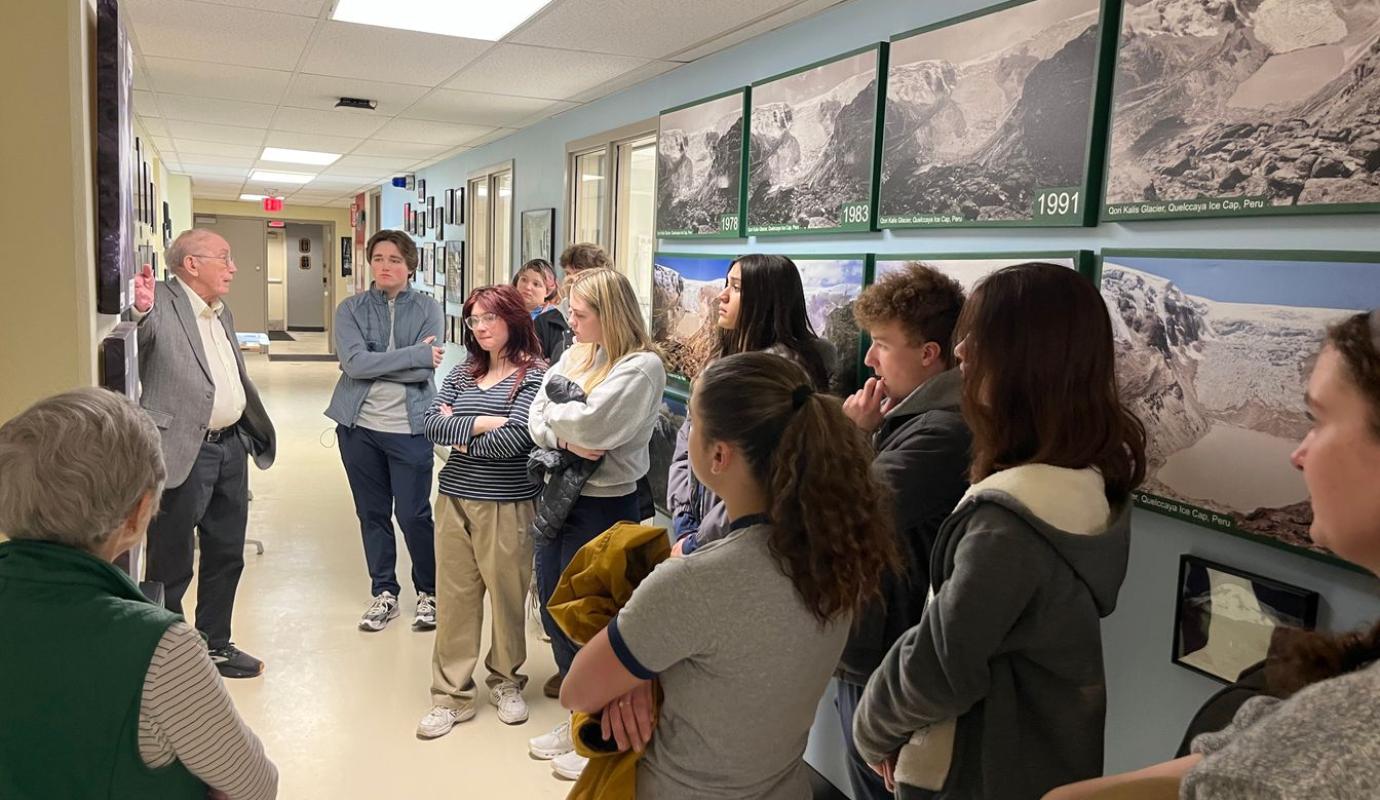
Upper school students in Applied Chemistry: Climate Change are spending the trimester learning how scientists study Earth’s atmosphere over long stretches of time. Along the way, they are asking questions about how researchers gather evidence, how scientific understanding evolves, and how we make sense of complex systems that span centuries and continents. At Wellington, students are encouraged to lean into this kind of complexity with curiosity and care, engaging with real data, learning from experts, and forming their own understanding through thoughtful analysis. As part of this work, students visited the Byrd Polar and Climate Research Center, where they learned from Lonnie Thompson and Ellen Mosley-Thompson, whose decades of research have helped shape what we know about ice cores and the stories they hold.
During the visit, students saw how ice cores are drilled, stored, and studied, and how layers of ice can preserve traces of air, sediment, and chemical markers from different points in Earth’s history. These frozen records allow scientists to explore patterns across time, including periods of warming and cooling, using physical evidence collected from some of the most remote places on the planet. Students also visited the Polar Rock Repository, supported by the National Science Foundation, where they learned how Antarctic rock samples are cataloged and shared with researchers around the world. The experience offered a rare window into how patient, long-term scientific work happens, and gave students a glimpse of research paths shaped by curiosity, persistence, and close attention to the natural world.