By Chris Robbins P '17 '22, upper school English
Editor’s note: Wellington's Stories of the Holocaust course has long challenged students to confront one of history's most devastating chapters through literature, testimony, and firsthand experience. Chris Robbins P ’17 ’22, who has taught this course in the upper school for a decade, created Wellington's 2023 WISE trip to Poland as an extension of that work. Three years ago, Robbins traveled alongside Wellington students to bear witness to that history. As our next group of students makes that same journey, we are honored to share her reflections from her first trip.
This piece contains reflections on genocide, mass death, and connects historical atrocity to present-day events. We share it in the spirit in which it was written: as a call to bear witness and act.
AUSCHWITZ - Before we visit…traveling by bus…
I’m struggling to put my thoughts and feelings into actual words. Excited – that would feel accurate and yet wrong. Visiting this site was always a seemingly unreachable dream for me. And yet, in an hour, I’ll be there. There – at a site where so much pain and suffering happened. So much death. The earth I will be walking on is full of the blood and ashes of hundreds of thousands of people – people who were killed because of their family lineage, because of their faith.
“Work will make you free.” All lies. Imagine showing up here and seeing that sign and then to be marched directly to a gas chamber. I don’t know who had it worse – the people who faced that immediate death or the ones who survived and had to live with the knowledge that their family members met that fate – that at any moment they would be next. Ashes like rain falling from the sky. Breathed in – what was once a life…being inhaled into another life.
And it wasn’t enough just to kill them. They were burned so that nothing remained – as if Hitler could just make it seem like they never existed. I think about Amon Goeth’s speech in the film “Schindler’s List” when he was about to destroy the Jewish Quarter in Krakow:
“Today is history. Today will be remembered. Years from now the young will ask with wonder about this day. Today is history and you are part of it. Six hundred years ago, when elsewhere they were footing the blame for the Black Death, Casimir the Great – so called – told the Jews they could come to Krakow. They came. They trundled their belongings into the city. They settled. They took hold. They prospered in business, science, education, the arts. They came with nothing. And they flourished. For six centuries there has been a Jewish Krakow. By this evening those six centuries will be a rumor. They never happened. Today is history.”
And this week I walked those streets. I drove past Plaszow – the camp Goeth ran. Nothing remained; it is a grassy, bushy plot of land. And a stone memorial to commemorate all who died there. Goeth was wrong. He could never wipe away the fact that the Jewish people were in Krakow. In fact, since nothing remains at Plaszow, perhaps it is the Nazis who have been wiped out.
The door to the gas chamber at Crematorium I, Auschwitz I — the only one the Nazis did not destroy.
But that is not entirely true either. Hatred does not disappear when the uniforms do. It changes, finding new language and new justifications. Standing in this place, it is impossible not to think about how intolerance takes root and how easily people can be divided. History does not repeat itself in the same exact way, but it asks us to pay attention. What this experience demands of us is that we remain aware, and that we choose something different.
I pass a graveyard and think about how many people during World War II were not afforded the same honorable burial. We drive through a town – a tree-lined street of Oświęcim. I imagine the train cars coming through. And suddenly, we have arrived.
AUSCHWITZ - After the visit…reflections…
I thought that after teaching the Stories of the Holocaust course in the upper school for the last decade, I would be prepared for this. I was so wrong – so very, very wrong.
The first thing that I noticed upon our arrival was that there were a lot of people there – yet it was so quiet. Our tour guide led our group through security and made sure that everyone’s headset worked. He began speaking – and I found myself standing at the gate to the complex. “ARBEIT MACHT FREI” – Work sets you free. And then we were through the gate and walking along a dirt pathway between brick buildings. So many brick buildings; it was easy to get them all confused. I looked down at the path and could make out broken bricks in the dirt – bricks that had once lined these streets. We enter one of the buildings and see facts and quotations hanging on the walls. “In the years 1940-1945, the Nazis deported at least 1,300,000 people to Auschwitz…1,100,000 of these people died in Auschwitz. Approximately 90% of the victims were Jews. The SS murdered the majority of them in the gas chambers.” Pictures came next. People being led off trains and onto the sorting platform. A close-up picture hangs on the wall of a Nazi standing next to an old man, both of their backs turned to the camera. We were told by the tour guide that right after this photo was taken, the man was sent to the gas chamber. This picture captured one of the last moments of his life.
Next – the room of shoes, the room of suitcases, the room of hair. A brick and stone wall where hundreds of people were shot and killed, one after the other, by a firing squad. The remains of a long gallows – just outside of the dining hall. Barbed wire fences surrounding us at all times. And then the most sacred place – seemingly a peaceful hillside, when in actuality a stone bunker containing the first of the gas chambers. We walked along silently (as we did during all parts of this visit), but the stillness in this room was different. It was so hard to look at a contraption that began the mass killings of millions, the one that remains when the Nazis tried to obliterate all other evidence of what they had done.
Thousands of victims' shoes on display at the Auschwitz museum, each pair belonging to a person who was killed here.
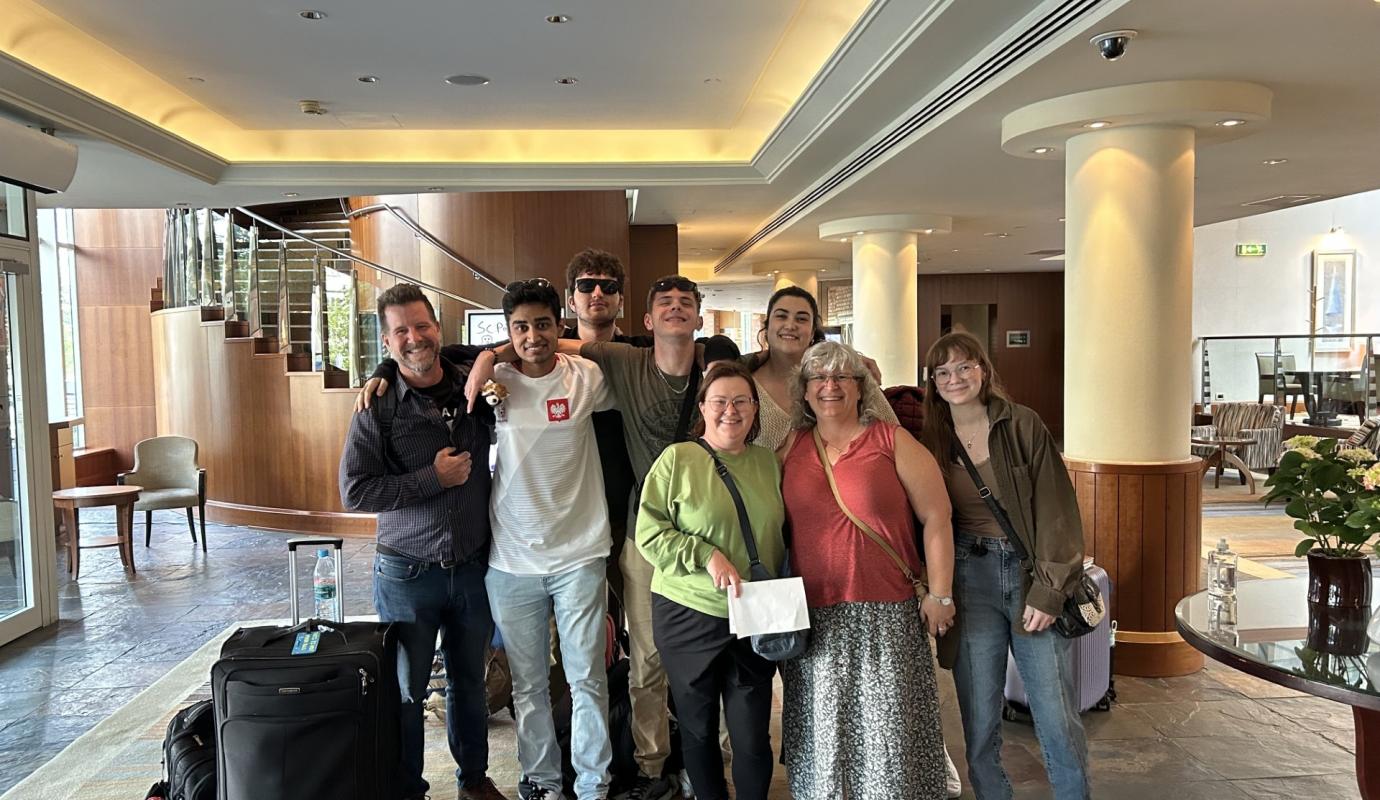
One of my strongest memories of this day will be when our group – five students and two teachers – stood outside of the gates of Auschwitz in a circle, hugging each other, telling each other how much we meant to each other, how proud we were to be here with each other. We had just shared one of the most significant experiences of our lives – together.
And even when we were finished with Auschwitz, we were not finished with the experience, for we next took a short, five-minute drive to Auschwitz-Birkenau – the site that became a killing machine. The famous archway where the trains entered is still standing, though the Nazis destroyed most of the bunkers holding prisoners. Still, the outlines of these buildings remain. A giant complex of long and narrow barracks first designed to house horses, then turned into “housing” units. One of these units had been reconstructed – the base was original but the walls and bunks were recreated. Rows and rows of 3-tier bunks. I remembered Elie Wiesel’s recollections from “Night” – how they slept six or eight to a bunk. I simply couldn’t imagine how that could happen as I stared at the recreations of the bunks. Bits and pieces of Wiesel’s story came back to me as I stood and looked over the camp; it felt as if a soundtrack played in my mind, his voice echoing from the past.
As I boarded the bus, I thought of a piece of Wiesel’s Nobel Peace Prize acceptance speech:
“We must take sides. Neutrality helps the oppressor, never the victim. Silence encourages the tormentor, never the tormented…action is the only remedy to indifference…one person of integrity can make a difference, a difference of life and death.”
And I vowed right then and there to make a difference. Always.
Wellington students at the entrance to Auschwitz I, beneath the infamous "Arbeit Macht Frei" — "Work will make you free."