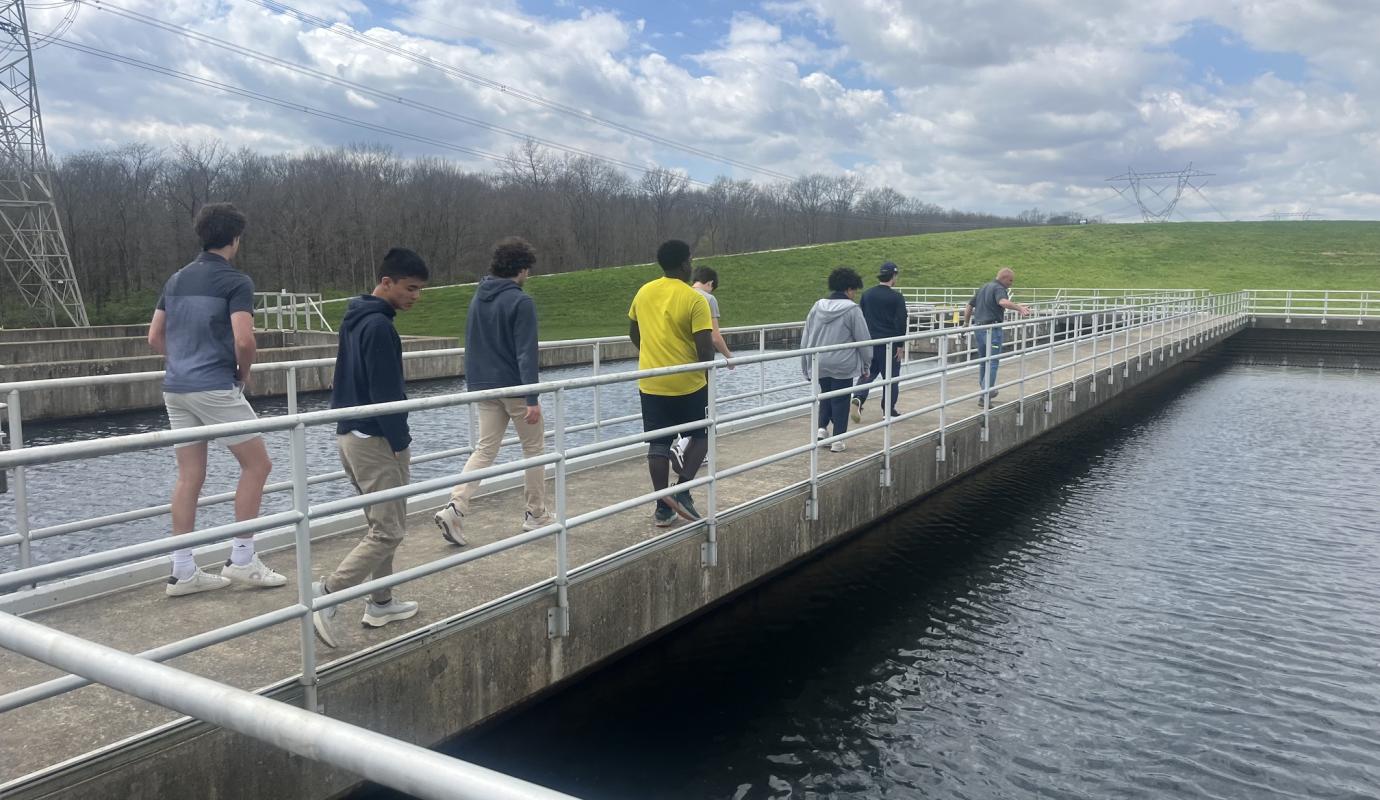
Students in Applied Chemistry explore water science through a visit and Q&A with Wellington alum Frances Wiggins ’16.
Students in Applied Chemistry: Utilizing and Safeguarding Our Essential Resource, taught by Joya Elmore P ’36 ’38, director of nature-based learning, recently visited a local water treatment site to see water science in action. During the trip, they met Frances Wiggins ’16, a watershed technician with Del-Co Water Company, and later followed up with questions about her work and career path.
Frances Wiggins, front center in a neon yellow sweatshirt and patterned hat, stands with Applied Chemistry students
Mrs. Elmore: Hi, Frances, could you please share a bit about your job with our community? And then, how did you get there? Tell us a little bit about your journey since you graduated from Wellington.
A: Hello! I’m Frances, though I went by Franny when I attended Wellington. I am the Watershed Technician for Del-Co Water Company in Delaware, Ohio. My job is to monitor the source waters for our drinking water treatment plant, which I do through employing a variety of field sampling (including sampling from a boat!) and lab techniques to collect data on raw water quality.
I graduated from Wellington in 2016 and attended Kenyon College, where I obtained a BA in biology. I had been considering studying the arts/humanities when I enrolled. The summer after freshman year, I deeply evaluated my interests, values, and underformed ideas of what I wanted (or rather, didn’t want) from a career. I wanted more job stability than I personally felt I would get from pursuing an art degree, and I knew I didn’t want the “English degree to business” pipeline I’d heard about.
I realized my long-time interest in the natural world, conservation, and climate change would suit a degree in biology. My course material then isn’t super relevant to my work now, except for, somewhat ironically, chemistry, a class I clawed my way through by the grace of a kind friend’s patient help. Most critically, I toured a wastewater plant as part of a microbiology class, an experience which proved formative even if I didn’t know it at the time. Even though my coursework never covered cyanotoxins or public outreach, it laid the foundations in microscopy and critically evaluating data and scientific literature, skills I make use of now.
Following graduation in 2020, I kicked around doing retail and administrative assistant work. I also spent half a year taking architecture classes because landscape architecture appealed to me for its intertwining of art, sustainability, and infrastructure. However, I didn’t feel ready to pursue a master’s degree, so I started keeping an eye on local utilities for job openings, having finally remembered that tour of a wastewater plant. I was hired at Del-Co Water as a part-time employee in 2023, was moved to full-time a few months later, and here we are!
Zoey Scott ’26: Is this the field you thought you’d be working in when you were a student at Wellington?
A: Ha! Not even remotely. I spent most of my electives at Wellington on English and art classes. I declined to take any of the more rigorous (multi-trimester) science classes beyond our general requirements. I did enjoy the single-trimester topic-based science classes a lot, though. Special shoutout to Mr. Frim's chemistry demonstrations.
Eli Cellino ’27: How did Wellington prepare you for college/your job?
Wellington places a strong emphasis on writing skills, which was supremely helpful as I was grappling with college essay work and learning technical writing. My foundation in writing from Wellington set me up to do well in college, even in forms of writing I had little prior experience in. Professionally, clarity of communication - the art of a well-constructed sentence - is incredibly valuable. There is vanishingly little that can be accomplished effectively without the ability to communicate your intent and goals legibly to different audiences. This spans emailing your coworkers to applying for a grant from the Ohio EPA to giving a presentation to 100+ peers.
Perry Oman ’27: How does severe weather change or impact your daily routine?
A: Mostly, it keeps me inside! We try to limit the worst weather we deal with to rainy days without lightning and winds below 30 mph. When we get severe rain events, though, I keep a closer eye on the Olentangy River. High rainfall can create high flow and flooding. Under these conditions, the water picks up a lot of soil and debris and absorbs a lot of runoff from the Olentangy watershed. I've done sampling runs during heavy rainfall to measure runoff impact, though I try not to walk around waving a metal stick in a thunderstorm!
Abbott Arthur ’27: How do the hours you work change based on the weather conditions?
My hours generally don't change. The work I do does, however. For instance, we don't apply copper sulfate to treat for algae on cloudy or windy days - algae needs to be at the water surface for the chemical to be most effective. In winter, we don't go out to sample on the boat because the water is dangerously cold.
Timchia Tubuo ’27: What’s your favorite thing about your job?
There are a lot of things I enjoy about my job, but my favorite thing is probably getting to work alongside the rivers over the course of the year. I've watched young deer pick their way across the riffles of the Olentangy in the early spring. This past winter, when the rivers were just thawing, a great blue heron landed barely 10 feet away from me before noticing I was there. I love that I get the opportunity to observe the outdoors just by going about my daily work.
Perry Oman ’27: What’s your favorite piece of equipment?
A: Probably the portable data sonde! It's a data logger and sensor platform about the length of your arm. Ours is able to measure pH, specific conductance, dissolved oxygen, turbidity, chlorophyll a, phycocyanin, and even nitrate content. This range of parameters is valuable for evaluating algal growth and water turnover in our reservoirs, where we most commonly dunk the sonde.
Isaac Xiu ’26: What is something you think our community should know about water conservation and environmental protection?
A: There’s a shocking set of numbers I always try to share with people when I discuss water conservation. The water treatment plant I work at can produce up to 28 million gallons of water a day (MGD). In the summer months, the plant averages over 20 MGD. In winter? That number drops to 4-5 MGD. A significant portion of water use in the summer comes from lawn irrigation, which can total 15 million gallons a day.
Mrs. Elmore: Lastly, we'd love to hear your favorite memory from Wellington AND what advice you'd give a Wellington student as they embark on their next chapter.
A: Favorite memory - I don't remember what year this was exactly, but a good friend of mine ended up being the announcer for the Spaghetti Dinner multiple times. In an effort to entice support/volunteers to run the event, at one Morning Meeting, he dressed up as Effie Trinket from the movie adaptations of “The Hunger Games.” He had a wig, a boa, makeup; he even gave a whole speech in an "Effie Trinket" voice, selecting "tributes" from the upper school to work the spaghetti dinner. It brought the house down, in a nutshell.
Advice – Explore your options!! I know high school can be a time of insane busyness, but it is also one of the times you’ll be most free to explore what you enjoy and are interested in. See if you can job shadow someone for a day. Look for summer internships that take high school students. Ask a variety of people how they got to where they are now. And it’s okay if you don’t know what you want yet. Follow your curiosity and see where it takes you.