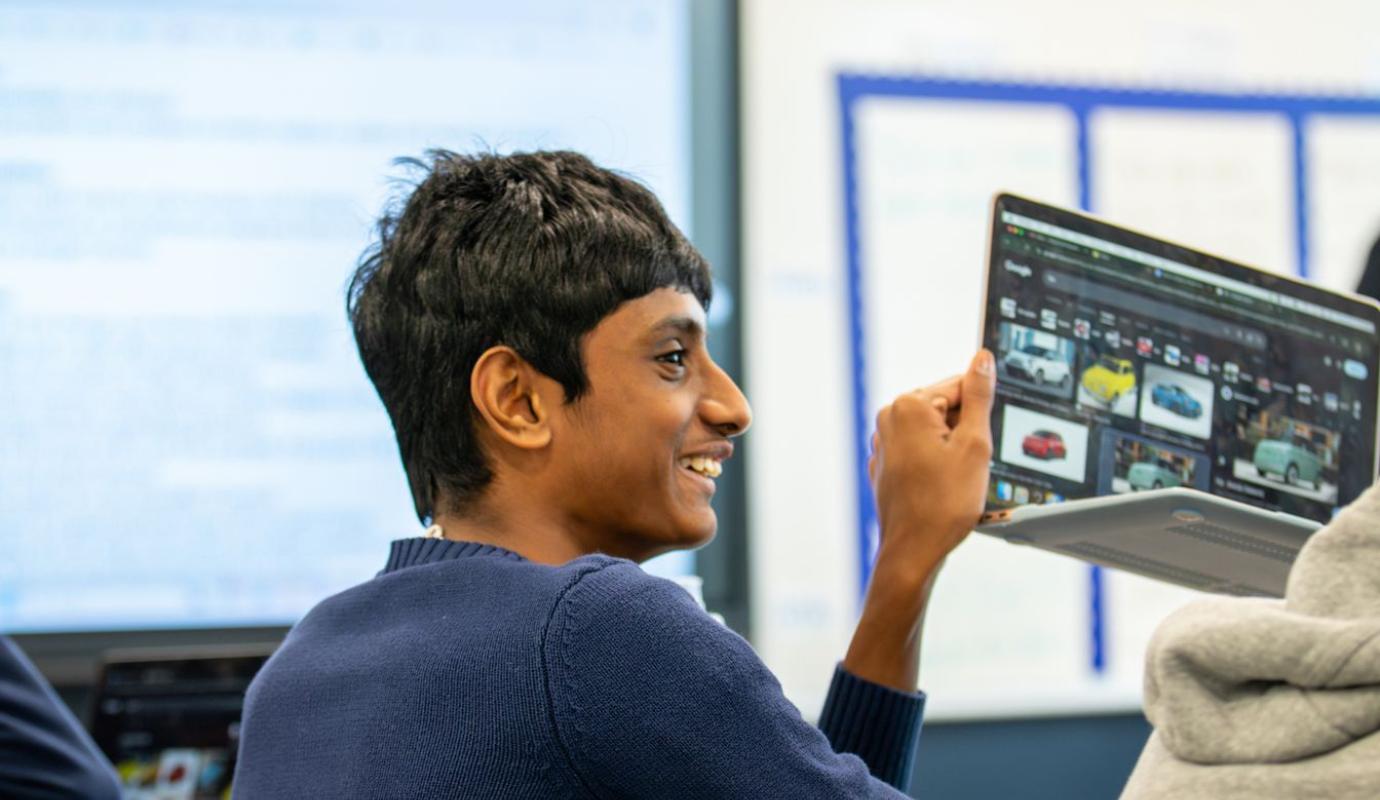
A Wellington graduate brought real-world math into an Algebra 1 Advanced classroom, helping students explore how budgeting, loan terms, and financial decisions shape the true cost of a car.
Middle schoolers may be a few years away from buying their first car, but that did not stop plenty of strong opinions, dream vehicles, and thoughtful questions during a recent visit from Wellington graduate Ryan Gill ’98. Now the owner of a multi-dealership auto group, Gill joined Anthony Constantino’s Algebra 1 Advanced class as part of a unit-long project designed to help students apply algebraic thinking to real-world financial decisions.
Students kicked off the project by selecting a dream car and a dream job, then determining whether purchasing that car would be financially realistic. For most, the math delivered a quick reality check. Using loan calculators, students explored how variables such as loan term and credit score affect the true cost of owning a vehicle, discovering that affordability is shaped as much by financing decisions as by sticker price. This foundational work gave students the tools to move beyond hypotheticals and begin asking more precise, informed questions.
With that preparation in place, students researched the car-buying process and developed questions for Gill to ensure they made the most of his 45-minute visit. Drawing on years of experience across every aspect of the auto industry, Gill shared insights shaped by leading a large operation and evaluating thousands of vehicles over the course of his career. He addressed student questions on topics ranging from total cost of ownership and interest rates to safety, environmental impact, and what makes sense for first-time drivers, helping students connect their mathematical models to real-world decision-making.
Rather than stopping at theory, the learning will continue. Next, students will be given a realistic high school student budget and asked to determine whether buying a car is financially feasible. Using systems of equations and inequalities, they will model this scenario and evaluate tradeoffs, applying algebra to a decision many will face sooner than they might expect. Grounded in math but rich in real-world context, the project challenges students to think critically, ask better questions, and see algebra as a practical tool they will carry well beyond middle school.