State of the School 2026
February 19, 2026
State of the School
Head of School Eliza McLaren delivered the annual presentation of the State of the School to the Wellington community on February 19, 2026. Accompanied by the Upper School Band, Ms. McLaren shared a comprehensive update on the state of the school and vision for the future. Highlights from her presentation and accompanying visuals and videos can be found below.
Grounded in Purpose, Built for Tomorrow

The State of the School is a moment to take stock— to celebrate what makes us proud, to be honest about the work ahead, and to recommit to the values that guide us. This past year at Wellington has been extraordinary. We launched a new strategic plan, strengthened academics across every division, elevated our athletics and arts programs, and invested intentionally in community. Enrollment is the strongest it has ever been. Early philanthropic support is propelling our campus master plan forward. But more than any single accomplishment, what defines this year is how we have come together. In everyday moments and in challenging ones, in cherished traditions and new beginnings alike, this community shows up for one another. That spirit is the Wellington Way—the blueprint that calls us to become the best versions of ourselves while helping others do the same.
We are living through a period of accelerating change. Our children are growing up in a world shaped by generative and agentic artificial intelligence, workforce transformation, and rapidly shifting expectations for success. At the same time, we see rising disconnection—a loneliness epidemic, fewer opportunities for genuine gathering, and increasingly curated digital experiences that blur the line between perception and reality. In a world designed for attention rather than understanding, it can become harder to show up fully, to think deeply, and to belong meaningfully.
That is precisely why schools like Wellington matter more than ever. Our responsibility is twofold: to prepare students for an AI-enabled world and to nurture what is uniquely human within them. Real learning and real character are forged in effort—in the difficult conversation, the challenging essay, the demanding practice, the speech that requires courage. We treat critical thinking as cognitive fitness, and we protect students’ attention accordingly. Our device-free school day, except for purposeful instructional use, ensures that students are present with one another, engaged in their work, and grounded in real community.
Our mission has never been more urgent: to help students find their purpose and realize their potential for tomorrow’s world. As Louisa May Alcott wrote, “I am not afraid of storms, for I am learning how to sail my ship.” Our work is to help students learn how to sail. And when I spend time with them—their curiosity, their resilience, their capacity to engage deeply—I have no doubt about what they can handle. It gives me every confidence to say tonight: the state of our school is strong.
Head of School Areas of Focus: Progress Updates
At the start of this school year, I shared five areas of focus that would guide our work for the 2025-26 school year, and I want to provide some updates on each.
-
Advance the Strategic Plan, including the Campus Master Plan
-
Elevate academic, athletic, and artistic excellence
-
Deepen the Culture of Challenge, high expectations, and shared purpose
-
Strengthen community engagement and school-parent communication
-
Build and develop leadership capacity across the school
The success of any head of school depends on the strength of the leadership team and the engagement of the Board of Trustees. I feel incredibly lucky to work alongside such a talented, thoughtful, and dedicated group of colleagues who challenge and inspire me every day. I am also profoundly grateful for the unwavering support of our Trustees whose partnership and trust have meant so much to me.
New Leaders this Year
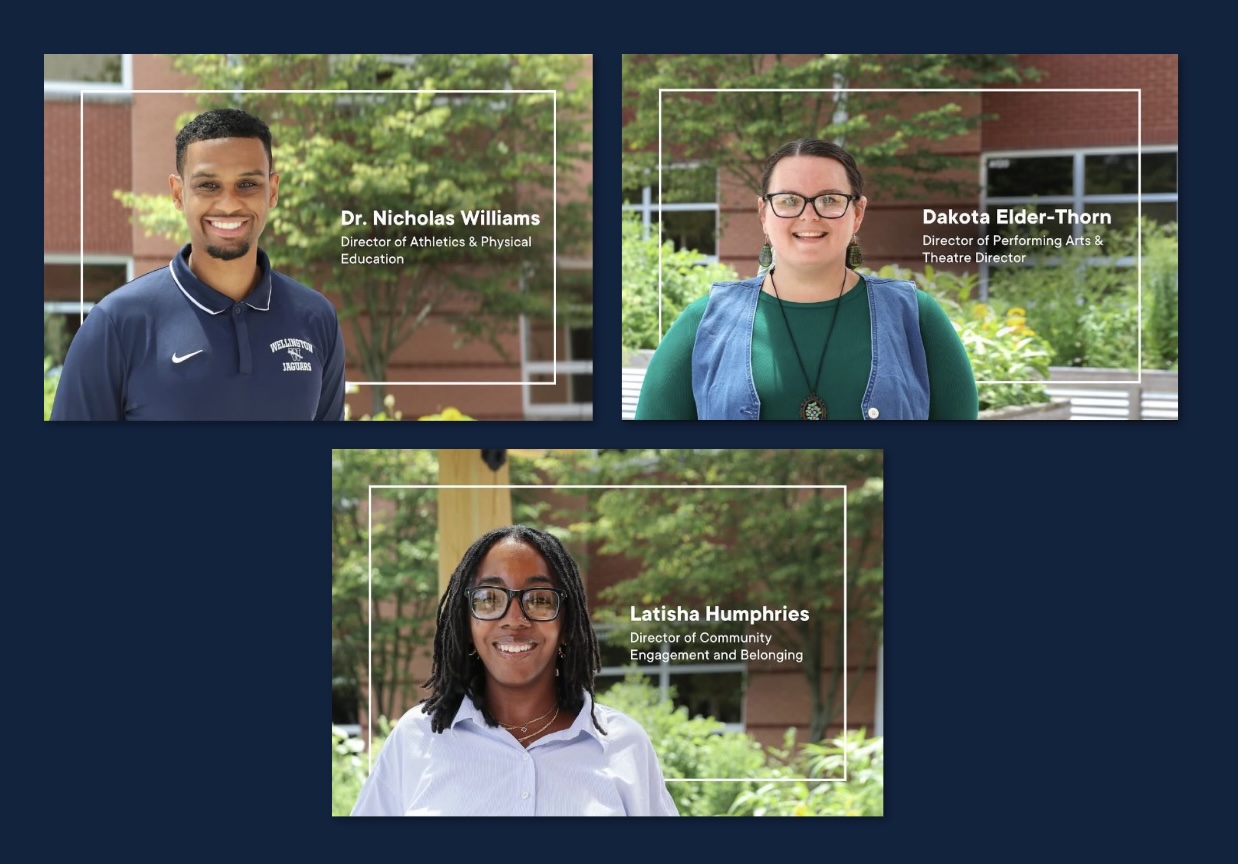
I would like to extend my gratitude and congratulations to our senior leaders who joined us new this year: Director of Athletics Nick Williams, Director of Performing Arts and Theatre Director Dakota Elder-Thorn, and Director of Community Engagement and Belonging Latisha Humphries. Each has hit the ground running this year, helping to advance our school in their respective areas of leadership.
New Leaders Next Year
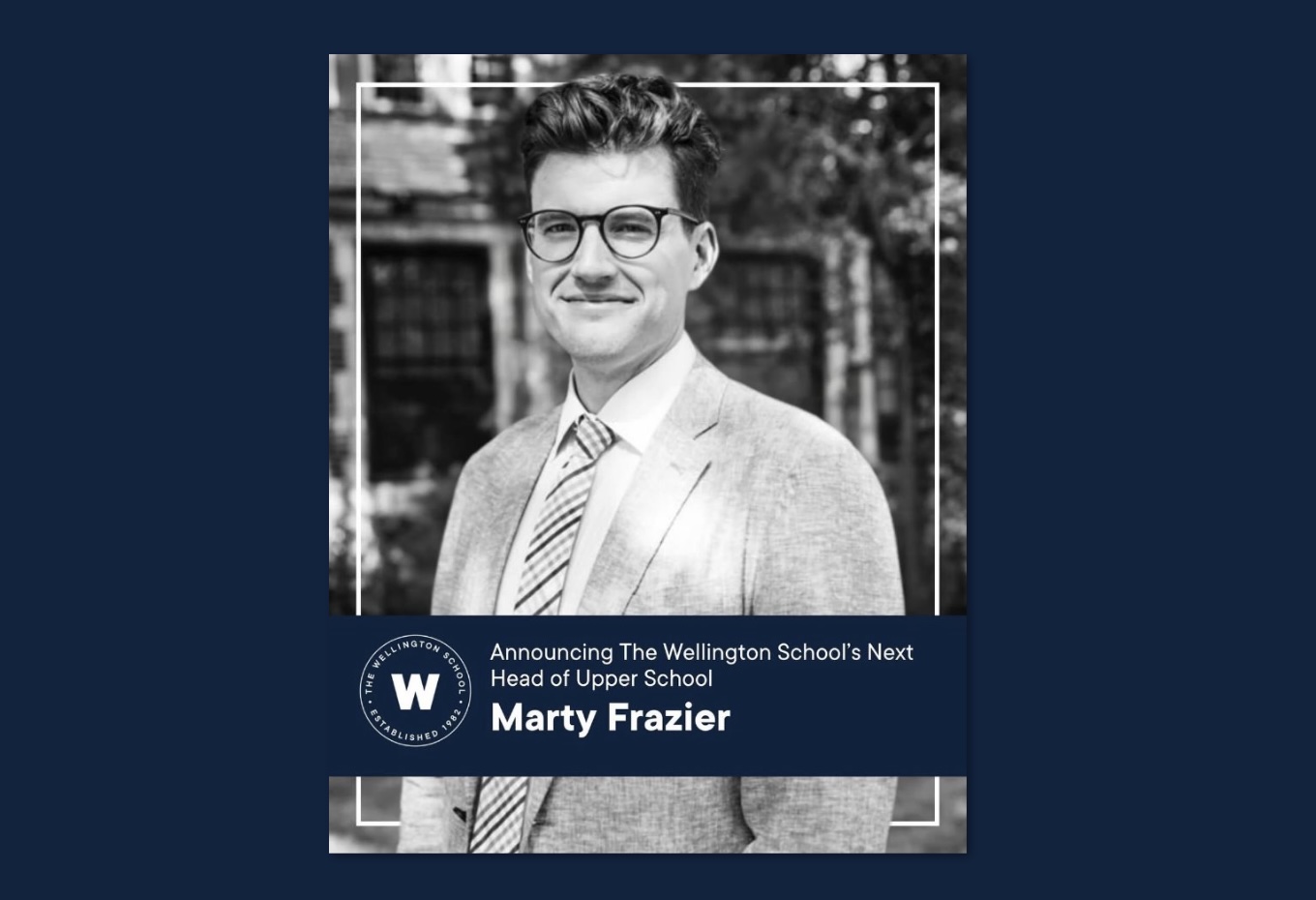
Marty Frazier will join Wellington as our next Head of Upper School. Marty joins us from Hathaway Brown School in Cleveland where he is currently the Dean of Faculty. He brings deep experience, a student-centered leadership style, and a strong commitment to supporting teachers and elevating academic and community excellence. Marty receives the baton of Upper School leadership from Rishi Raghunathan who has guided the Upper School beautifully over these last six years.
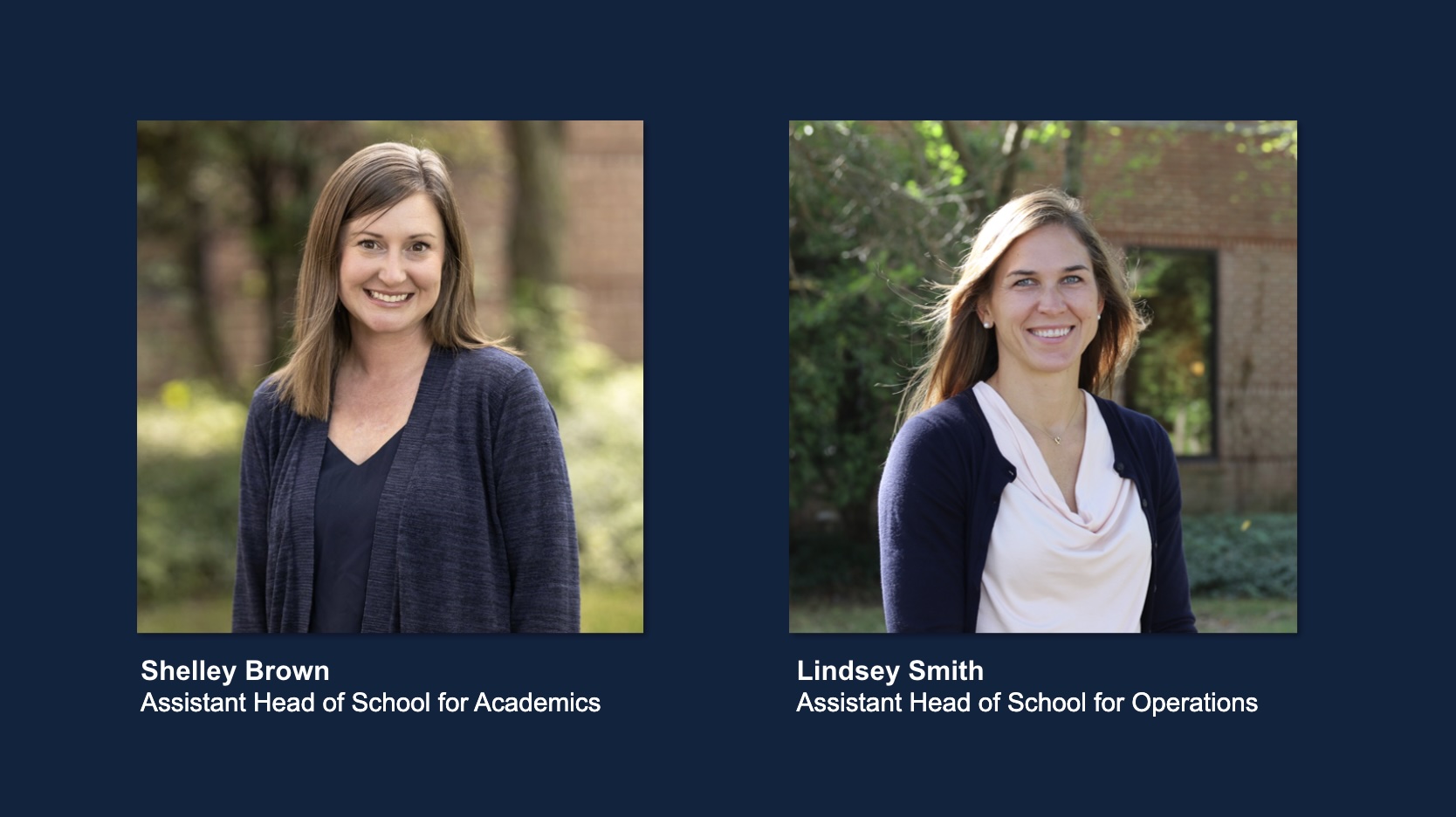
Shelley Brown will step fully into the Assistant Head of School for Academics role. She has already made a tremendous impact in this all-school academic work. Joining Shelley next year at the Assistant Head of School level is Lindsey Smith, whose title will shift from Chief Operating Officer to Assistant Head of School for Operations to more accurately reflect the scope of her role and responsibilities.
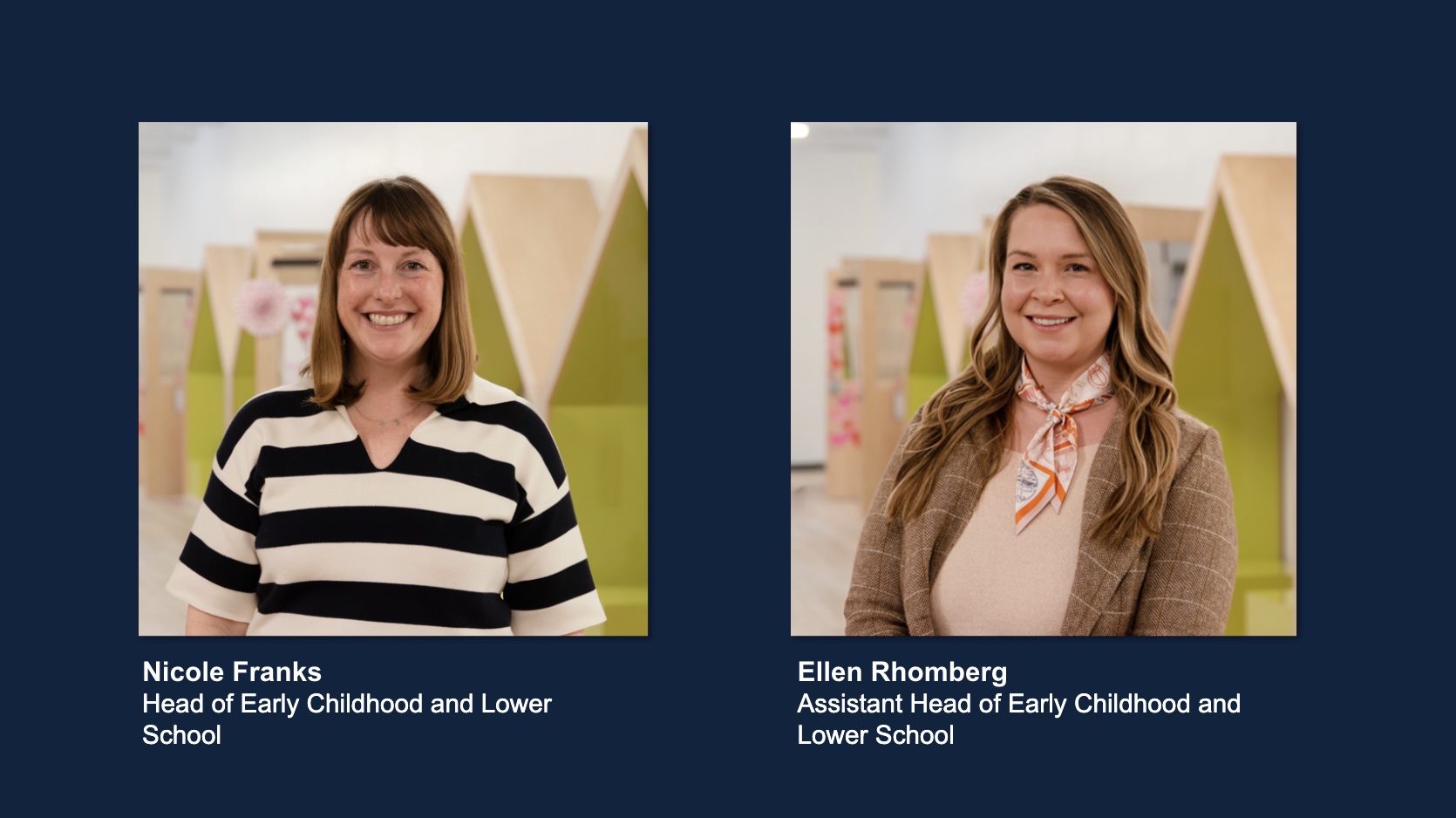
Nicole Franks joined Wellington as Assistant Head of Early Childhood and Lower School this year, bringing a wealth of experience and outstanding leadership. Beginning next school year, Nicole will serve as our Head of Early Childhood and Lower School. Ellen Rhomberg will partner with her as Assistant Head of Early Childhood and Lower School.
Throughout this year, we’ve seen meaningful progress—from parent programming to Sunday Suppers to clearer communication rhythms to deeper partnership around student growth to improvements in how and when we communicate.
We continue to identify communication as an area of ongoing needed progress. Through parent surveys, we hear that we get both too many emails and at times not enough communication or inconsistent communication from year-to-year about their individual child’s academic progress. I want you to know this is something we are actively working on, and I hope the progress you have seen this year will continue in the future.
We put renewed focus on technology usage – for example, going completely cellphone free throughout the entire school. We have also renewed our commitment to following dress code and attendance policies, and I thank parents for their partnership on that.
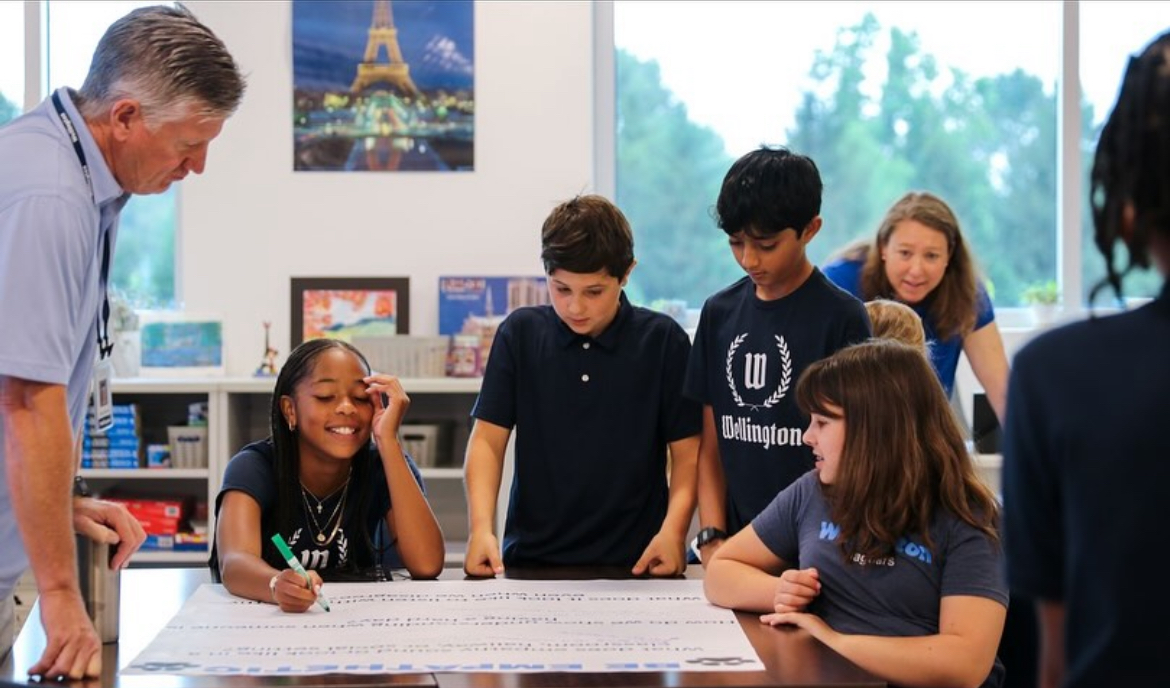
One thing I have been particularly proud of is the student-led setting of community expectations. In my view, student culture is best when all members of the community – students especially – hold each other accountable to our values. The Wellington Middle School Community Expectations Committee posted throughout the school: “We commit to building an inclusive, safe, engaging, and joyful community that embraces our Wellington values and holds each other accountable. As members of this community, we can be ourselves while striving to be responsible, curious, ambitious, and empathetic.”
Elevate Academic Excellence
At Wellington, we are deeply committed to increasing opportunities for students to stretch themselves—academically, creatively, athletically, and personally. We also believe that excellence should be measured thoughtfully.
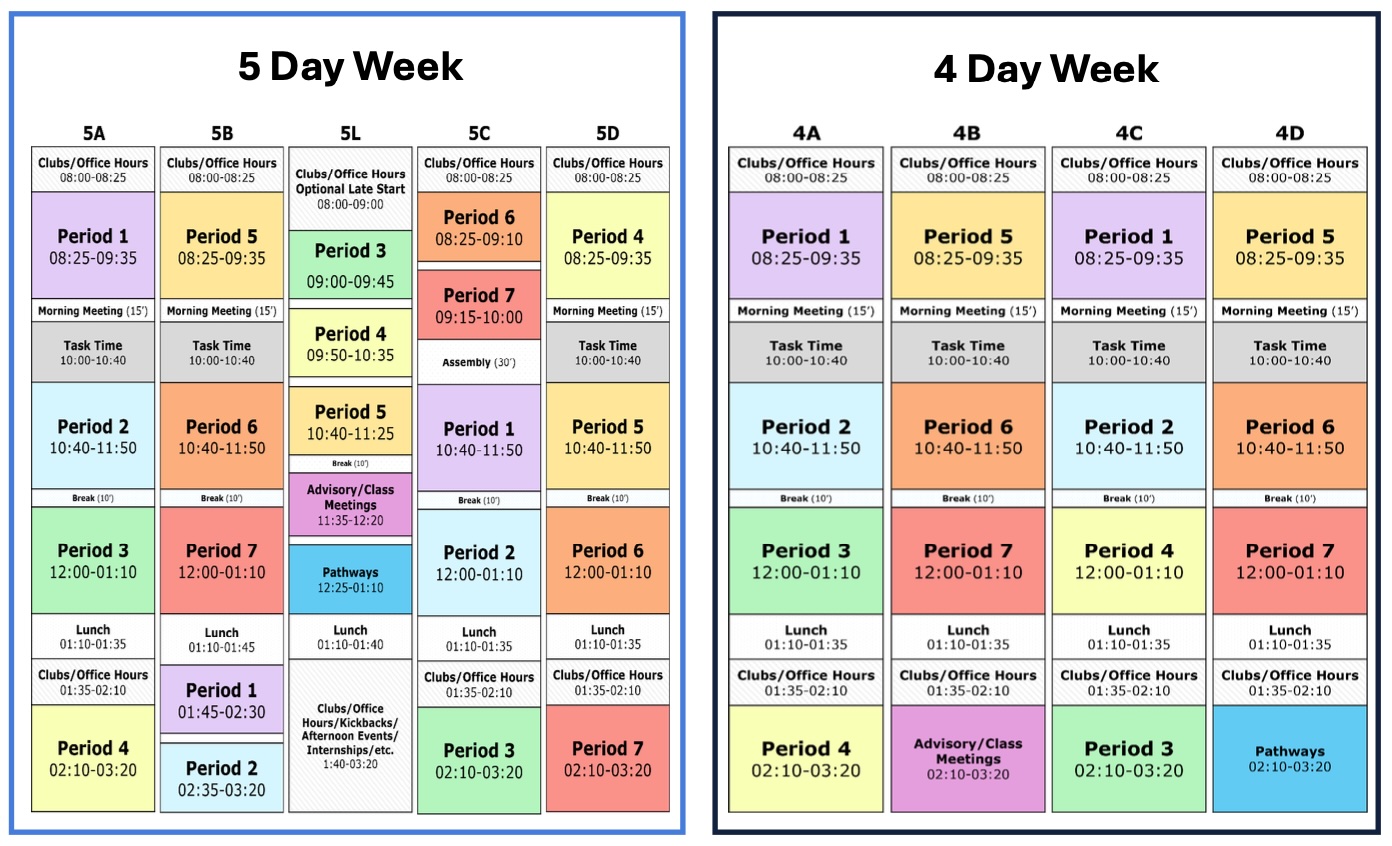
This year, we overhauled the upper school schedule to increase instructional time while preserving signature programs, independent work time, and student-teacher consultation time—affectionately known as TASK time.
We've also made major progress toward comprehensive curricular documentation and greater consistency in academic policies. Our curricular leads have worked to ensure a consistent and focused scope and sequence, access to resources, collaboration, and clear program articulation. Adjustments in the pathways available to our students ensure all have access to the level of support and challenge we want for them. And, we have done this while preserving Wellington's signature teacher autonomy and creativity.
To better prepare students for the future, we dedicated a portion of our professional development efforts for the year to enhancing our approach to project-based learning. The video below captures this work in action and highlights why we feel it’s so fundamental to our approach to future-focused education.

When we think about future-focused learning, we're also being thoughtful about how we approach AI in the curriculum. At Wellington, we view Artificial Intelligence as a thoughtful partner—used to enhance learning, foster creativity, and support individualized instruction—while always centering human relationships, cognitive development, ethical use, and academic integrity.
We embrace AI as a tool to help students and educators grow as responsible, curious, and capable learners, ensuring its use aligns with our mission and educational approach. Shelley Brown and Director of Technology John Kruzan have been spearheading efforts to ensure we are using AI effectively and appropriately in every corner of the school.
Each year, we review our upper school course offerings to ensure they match the skills our students are building, the content they need for what comes next, and the level of challenge they're ready to take on. This review also helps students create strong, authentic transcripts that reflect both rigor and personal growth.
Upper school courses are designed to build independence, strengthen critical thinking, and develop students' confidence in tackling complex work. I'm particularly proud of the expanded course offerings in Upper School for next year. We have added additional levels for courses in 9th and 10th grade, so for example, there are now on grade-level 9th and 10th grade English courses as well as honors level 9th and 10th grade English courses. In 11th and 12th grades, we are providing the opportunity for students to select from a host of college-style seminar electives for English, or they may choose to take an advanced literature or advanced composition course that leads to the advanced placement exam. These changes will be shared in full at upcoming curriculum nights.
New Courses for 2026-27 School Year
English
-
Honors English 9
-
Honors English 10
-
Advanced Literature and Composition
-
Advanced Language and Composition
History
-
Honors Humanities 9
-
Advanced United States History 10
-
Advanced Government
Mathematics
-
Honors Geometry
-
Honors Algebra 2
-
Advanced Precalculus
-
Advanced Calculus AB
-
Advanced Calculus BC
Science
-
Honors Integrated Science 10
And these changes matter because they reflect our ongoing commitment to a challenging and supportive academic program in which students have agency and opportunity to pursue their interests.
Our course nomenclature also now more clearly reflects what colleges look for in transcript strength. It's our responsibility to keep pace with changes in college admissions to position our students as well as possible for the colleges and universities of their choosing.
When we talk about elevating excellence across the curriculum, we have to talk about supporting our outstanding teachers. I am very proud that this year we tripled the professional development budget, and teachers are taking advantage of more opportunities.
Additionally, we made strategic hires to support teachers in a significant way. Many of you may not realize that our Upper school teachers currently teach five courses as part of their full-time load.
One of my main goals for this year was to reduce this to four courses to give our teachers more time for collaboration, planning, and meeting with students. I'm thrilled to share that the standard teaching load next year for both upper school and middle school teachers will be four courses instead of five.
And when aiming for excellence in our curriculum, we need to be able to measure our efforts. When visitors ask how schools measure success, many point to college lists or standardized test scores. We have those—our students perform, on average, a full quartile above on standardized assessments from 1st grade through 12th, and we prepare students to get into and do very well in college. But we believe that how students experience learning matters just as much as outcomes.
This is where we have developed an innovative software to help us. The Wellington Initiative is a research-based platform that helps schools measure student engagement.
Engagement, as we define it, occurs when students are both challenged and enjoying their learning. Students report on this six times a year, providing us with actionable data about their classroom experience.
On this slide, each dot represents a middle or upper school student this year. You’ll see that the vast majority fall in the upper-right quadrant—students reporting that they are both challenged and loving their courses. That is exactly where we want them.
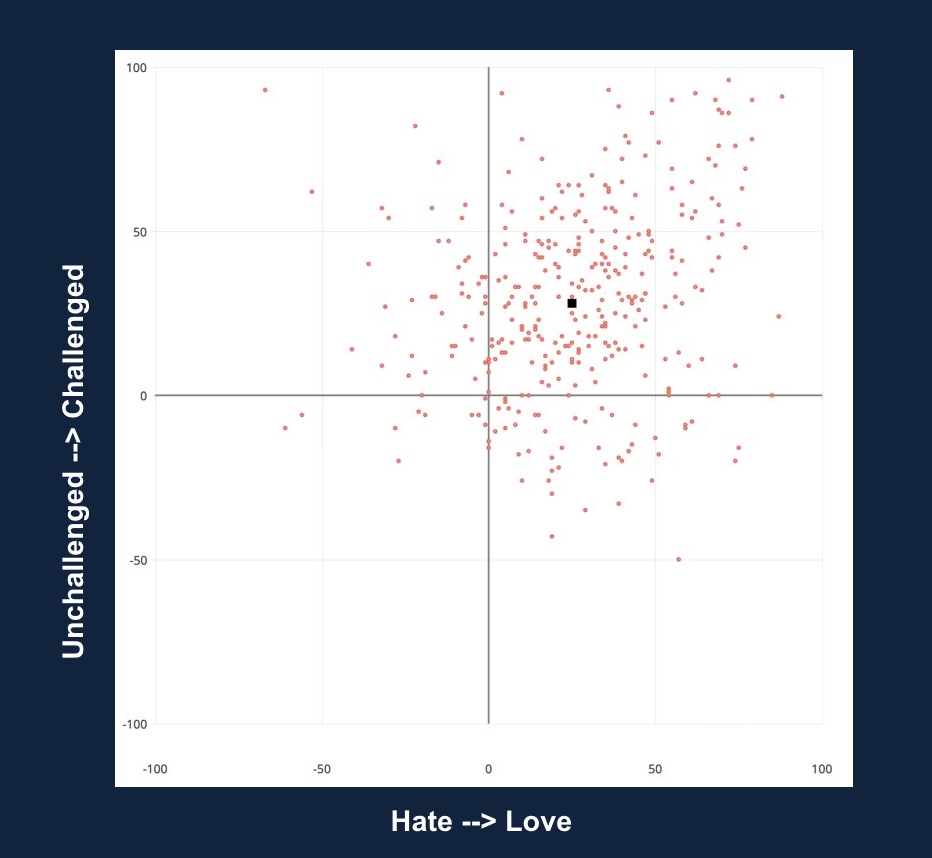
We use this data, alongside course surveys, not as an evaluative tool but as a listening tool—one that helps us refine practice and continuously improve. Today, more than 200 schools nationwide use the Wellington Initiative, extending Wellington’s impact beyond our campus while also creating a meaningful alternative revenue stream for the school.
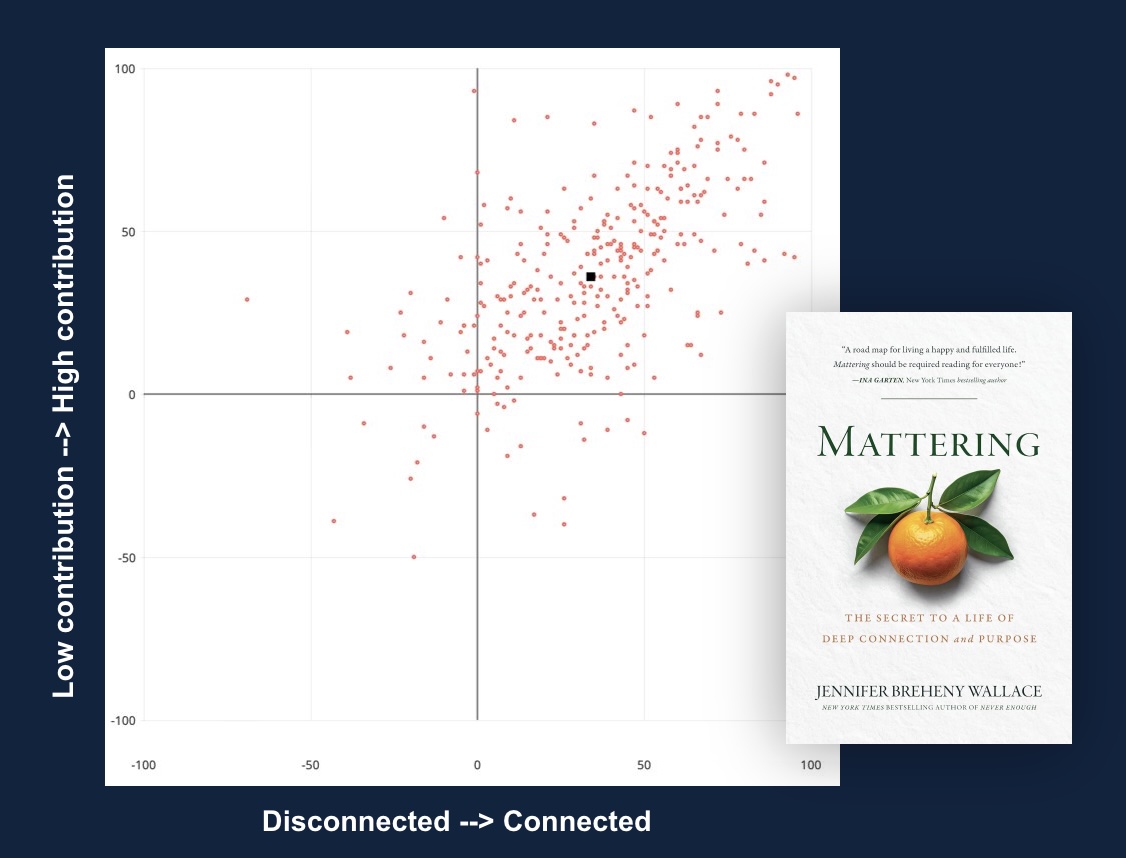
This year, we added a new tool: the Mattering Index. Based on Jennifer Wallace’s work, the mattering index measures students’ sense of connectedness and sense of contribution.
The data makes me very proud: the overwhelming majority of Wellington students report a high sense of connectedness and a high sense of contribution, meaning we’re not just saying they feel like they belong and they matter, we’re hearing it from them. And of course the handful of students who report low levels of mattering are ones we identify and support, as Wellington is a place where no students slip through the cracks.
Financial Overview
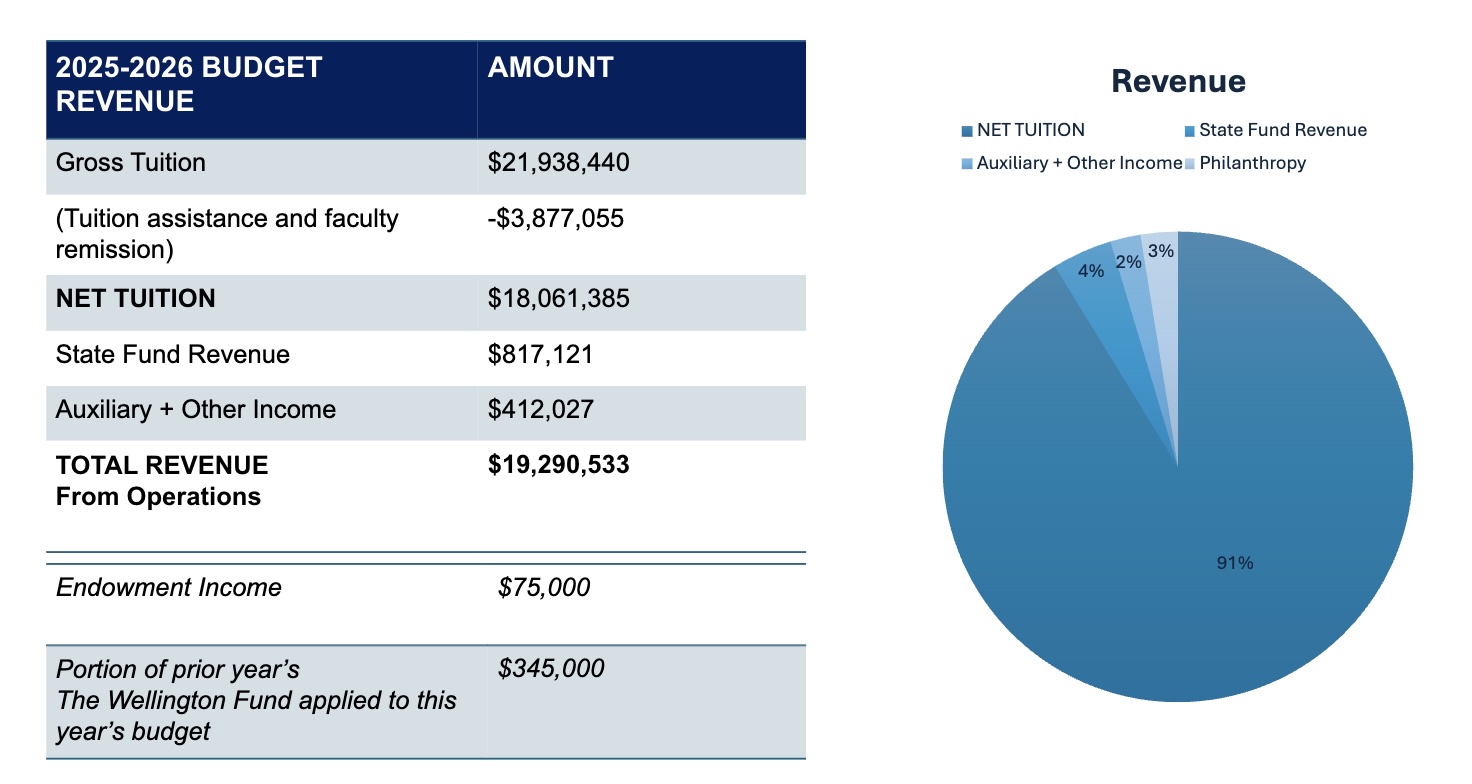
A budget is a reflection of what we value. Our financial health is directly tied to how well our investments align with our mission and the daily experience we seek to create for students. Wellington is in a strong and stable financial position: no debt, approximately $10 million in cash reserves, and a growing endowment of $8 million. We are sustainable, resilient, and well-positioned to invest in what matters most: our people.
In Fiscal Year 2026, 91% of Wellington's revenue comes from net tuition after tuition assistance and remission. Tuition remains our primary income source and allows us to deliver the full Wellington experience. The Board is committed to supporting socio-economic diversity. Our tuition assistance program supports 33% of students, including 8% who are children of faculty and staff receiving 50% tuition remission.
Additional revenue comes from auxiliary programs at 2%—summer programming, aftercare, enrichment, the Wellington Initiative, and rentals. Congratulations to Gina Spicer on the highest grossing summer program in Wellington's history last year! We also receive modest state revenue to cover compliance requirements.
The school anticipated approximately $835,000 in restricted and unrestricted giving this year. However, the finance committee balances the budget before annual giving—meaning essential operating expenses are covered before relying on philanthropy. This allows philanthropic dollars to fund additional investments in people, projects, and tuition assistance. This practice of establishing a pre-philanthropic surplus is rare and a clear indicator of strong financial health and thoughtful stewardship.
The school draws 3% annually from its endowment, providing $75,000 this year. This is an area poised for growth—our endowment has increased from roughly $3 million to $8 million thanks to the Scantland family gift earlier this year, which will allow us to take a greater draw in years to come.
Additionally, we applied $345,000 from last year's Wellington Fund to this year's budget.
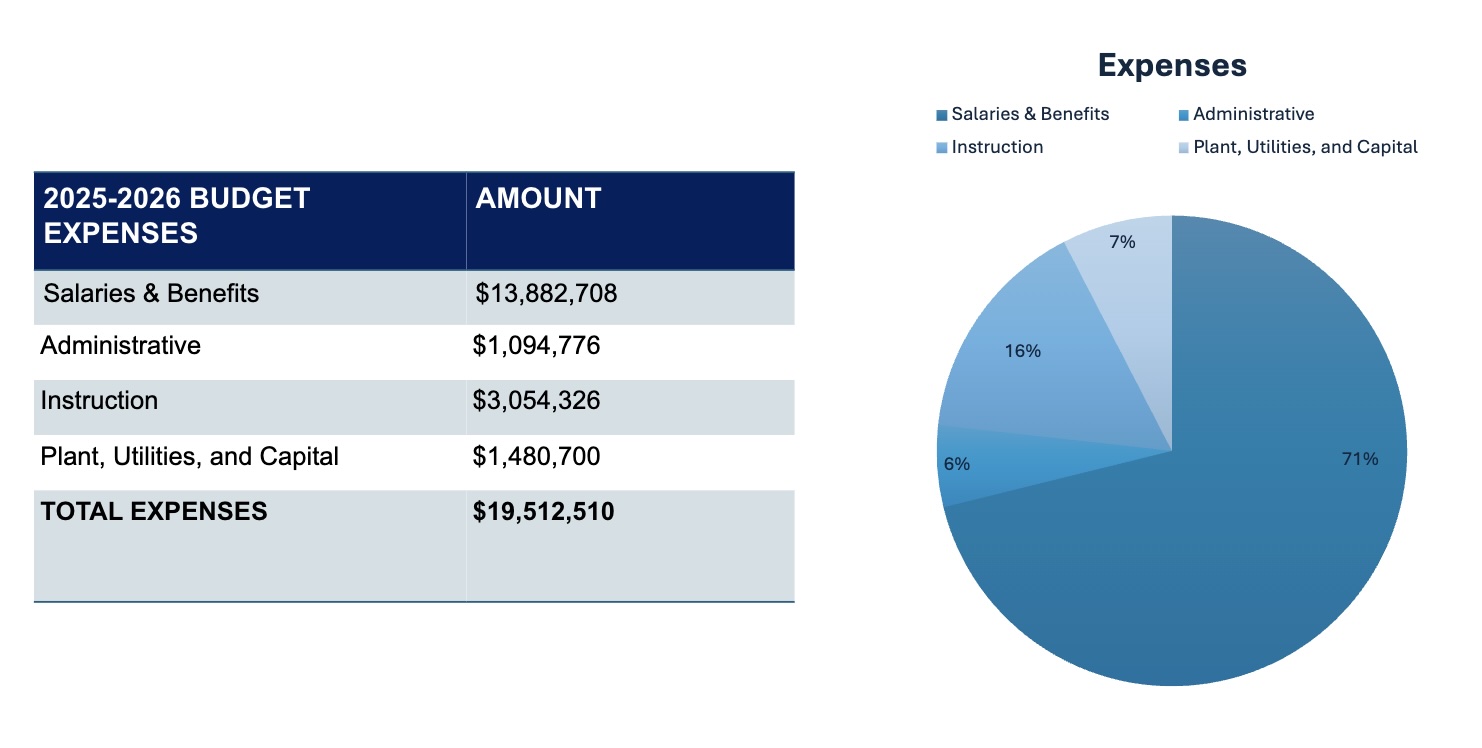
Wellington's largest investment is in our people. Salaries and benefits account for 71% of expenditures, reflecting our commitment to attracting and retaining outstanding educators and staff.
Program and instructional resources represent 16% of our operating budget, including curriculum, learning supplies, and international travel. Campus operations account for 7%, covering safety, facilities, and utilities. In many independent schools, these figures are reversed, with a larger share devoted to facilities. At Wellington, our budget reflects our values. By not over-investing in buildings, we are able to prioritize investments in great teaching, meaningful programs, and the daily experiences that matter most for students. This is one of the ways we steward tuition dollars thoughtfully—focusing our resources where they have the greatest impact on student learning and growth.
And administrative expenses account for 6%—these include professional development, technology, legal, and compliance.
The budget process begins each fall as leadership and trustees project enrollment and discuss tuition and salary increases, approved in December.
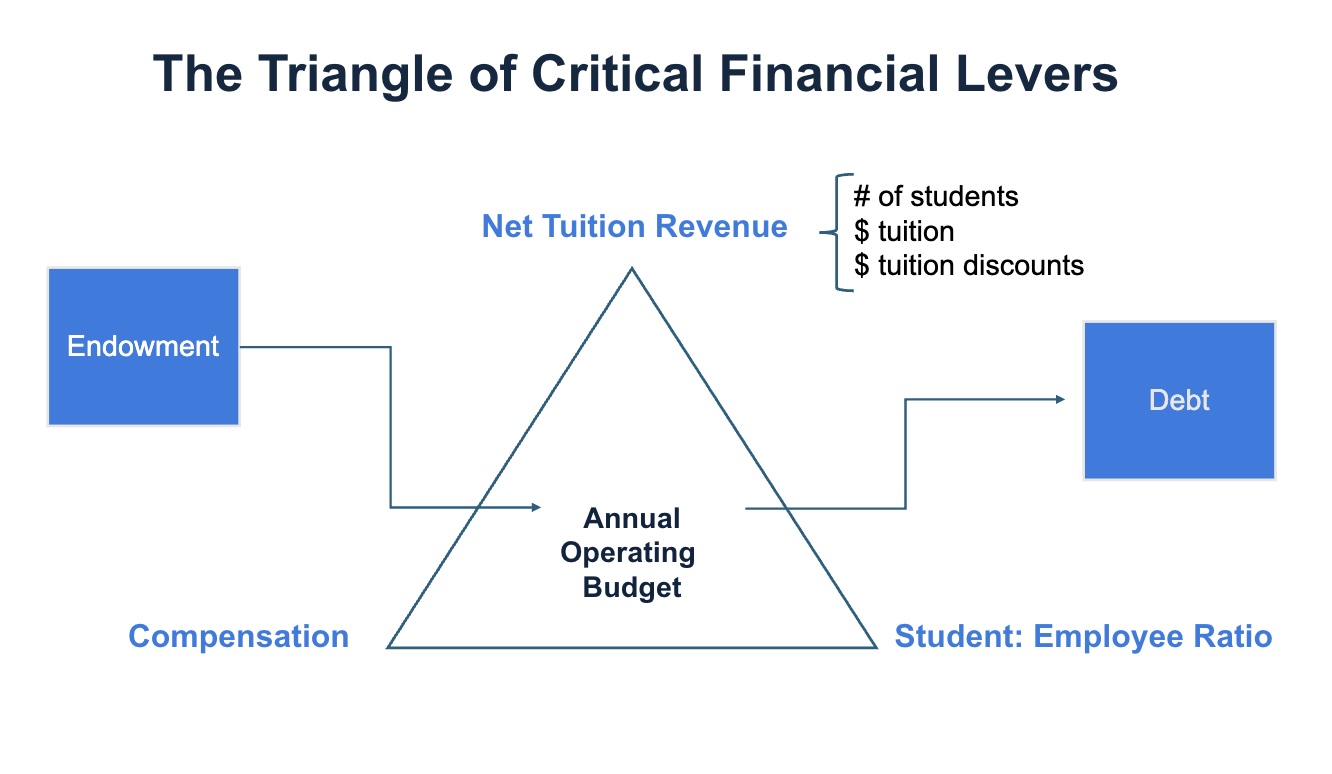
Independent schools traditionally manage three budget levers: tuition, faculty-to-student ratio, and compensation. At Wellington, we're firmly committed to maintaining small class sizes and low faculty-student ratios, so that lever is not one we're willing to pull. That leaves tuition and compensation, which exist in constant tension. The Board is deeply mindful of affordability while holding a clear north star: attracting and retaining the best educators possible.
Over the last two years, the Trustees increased tuition by an average of roughly 5.5%. This increase translates directly into salary and benefit increases for our outstanding teachers. For families, tuition continues to include lunch, textbooks, supplies, athletics, performing and visual arts, growth-mindset experiences like our ski program, most field trips, and overnight experiences starting in fourth grade—including international travel in junior year.
We also recognize the essential role of tuition assistance. The Board has increased the tuition assistance budget at a higher percentage than the tuition increase, allowing us to support families more meaningfully. Tuition assistance now also applies to aftercare—an important step in ensuring all students can participate fully in school life. We've also expanded aftercare offerings, introduced pre-registration discounts, and added childcare options during school-year and summer holidays.
I was proud to share with faculty last Friday that for the second consecutive year, we've offered the largest teacher salary pool increase in Wellington's history. This reflects our commitment to lifting salaries toward the top of independent school benchmarks while working toward competitiveness with public schools.
And, for the first time in Wellington's history, we'll soon have a meaningful fourth lever accessible only to the most well-established independent schools: endowment revenue.
Major capital expenses aren't included in our annual operating budget—they have separate budgets and revenue sources. Wellington does not use tuition dollars for major construction. The buildings around us have been paid for by the generous philanthropic support of members of the community.
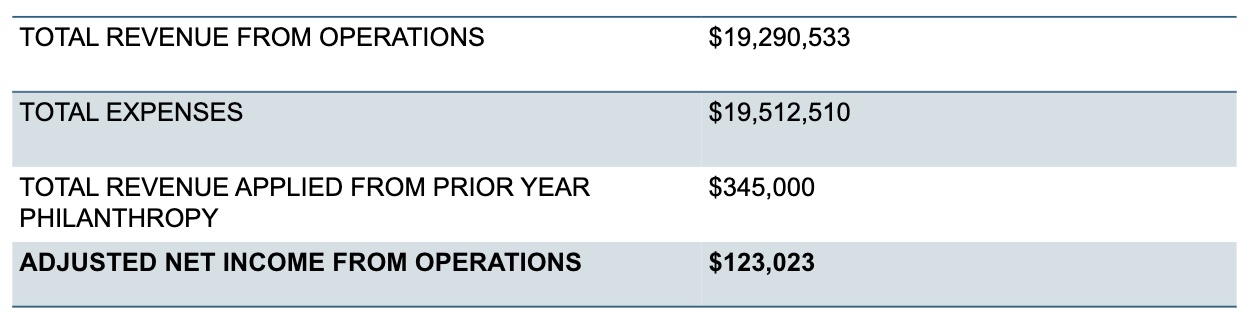
Examples of what the OPERATING budget does not include (i.e. these come from cash reserves, restricted giving, or capital giving)
- Kinder Wing renovation
- Upcoming renovations
- Multi-year investment in LTRS Science of Reading training for Lower School faculty
- Turf field replacement
At last year's State of the School, I announced we'd be moving forward with the Croft Family Kindergarten Wing thanks to the generosity of Jim and Michelle Croft. I'm thrilled to share that we completed this project on time and under budget. Fifty-four kindergarten students and six kindergarten teachers are benefiting from this space right now.
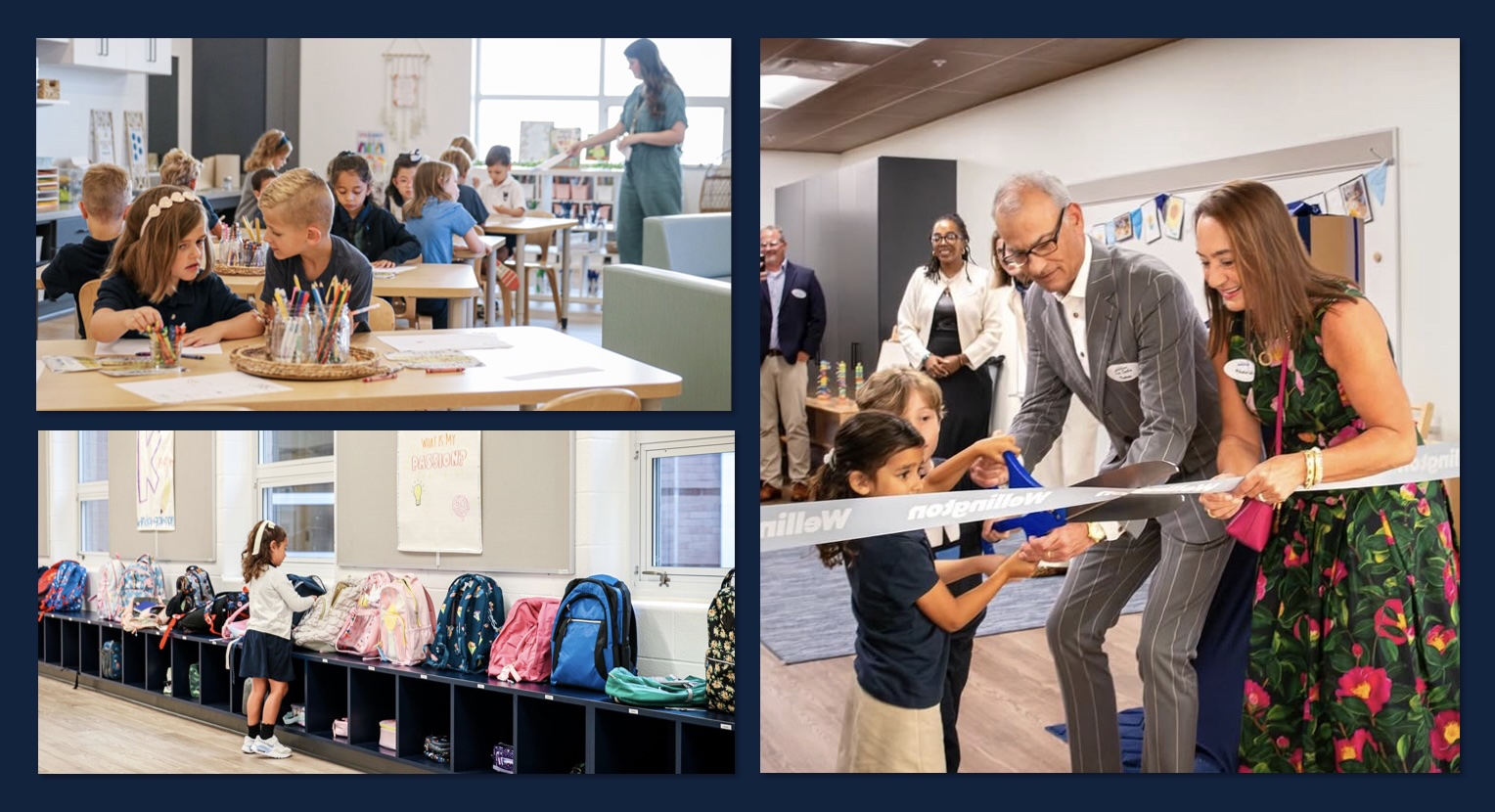
Another major investment outside the operating budget that is less visible but similarly transformative is a three-year professional development project where 20 Lower School teachers are becoming certified in LETRS—the preeminent master's degree level program in the science of reading. We are a science of reading school. Our students' reading achievement surpasses national averages by around 30%, and we're grateful for the major philanthropic support that makes this possible.
Enrollment Overview
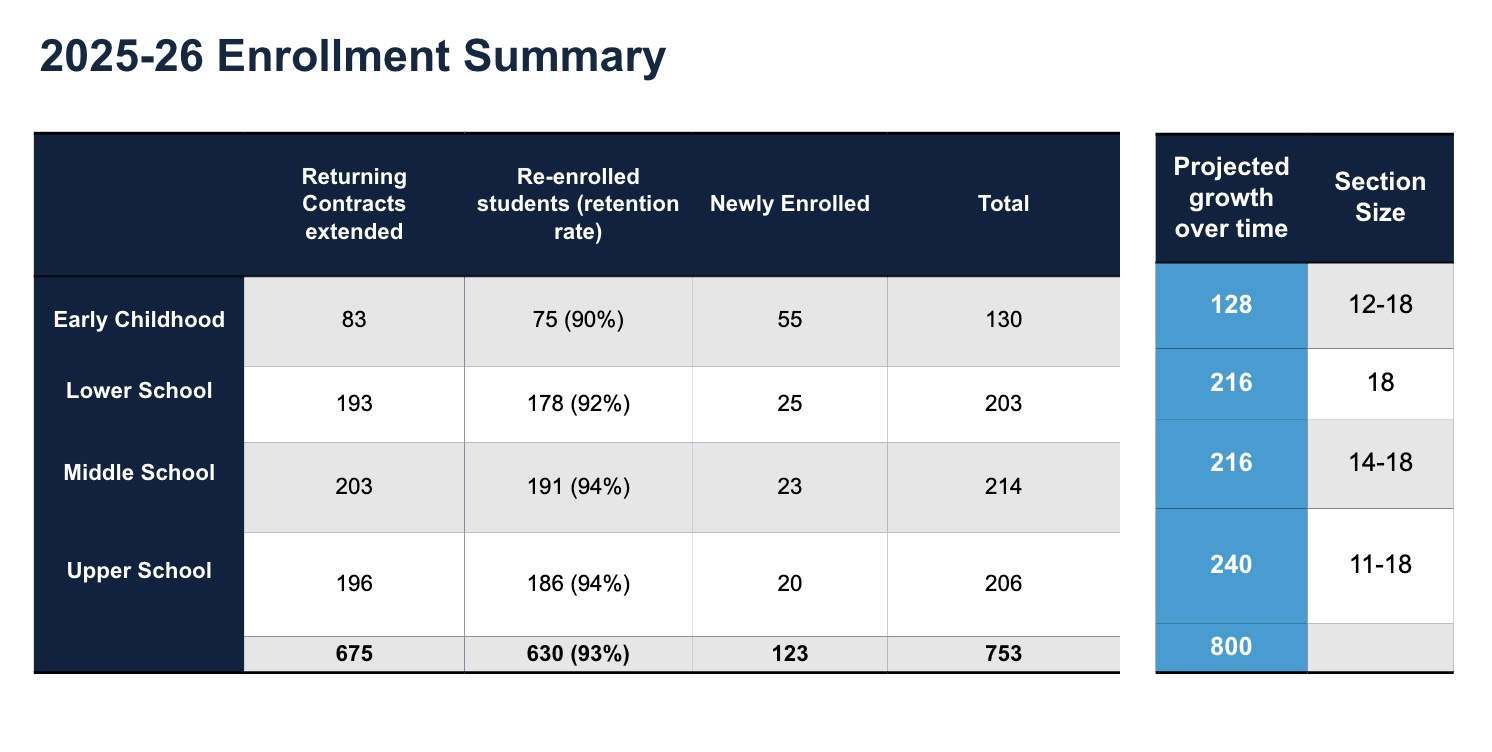
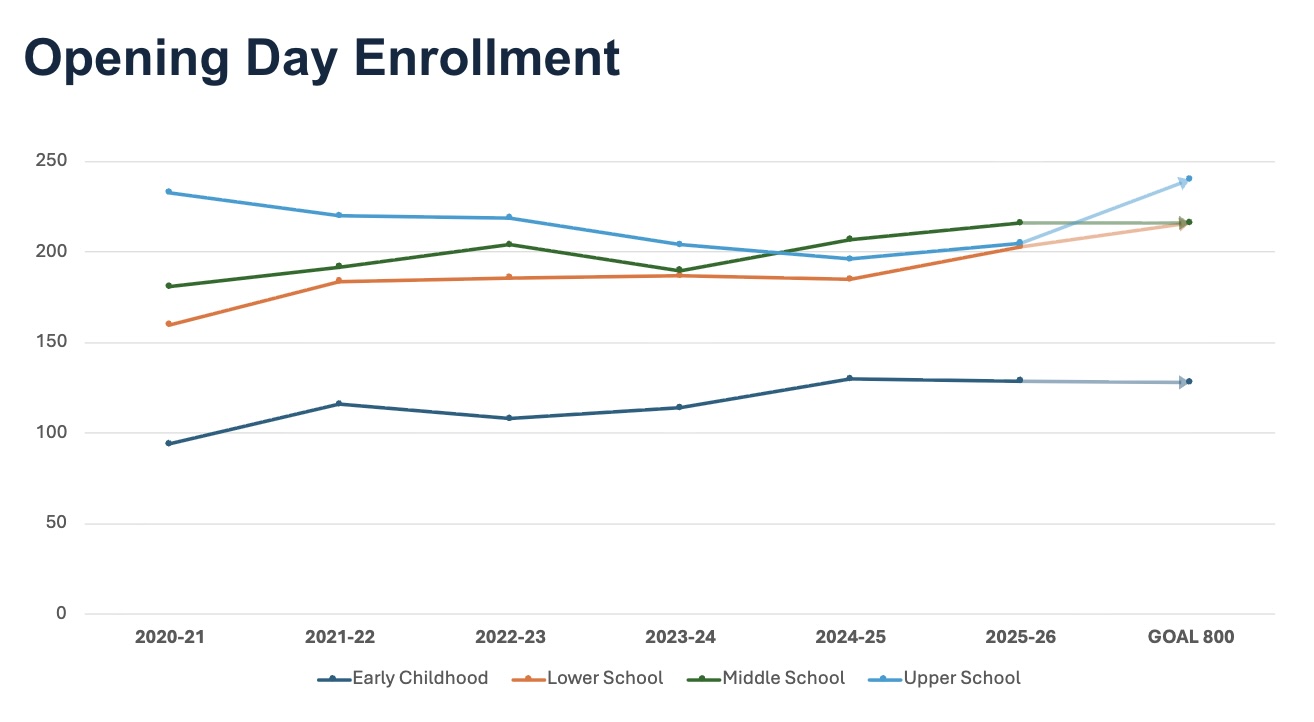
This year, we welcomed the largest enrollment in the school's history: 753 students, including 123 new students. We saw particularly strong demand in early childhood and lower school, a trend we expect to continue, especially at kindergarten and first grade. Please help spread the word: Little Jags and PreK are the ideal entry points for Wellington, as waiting until kindergarten means the possibility of limited space.
Wellington continues to prioritize a diverse student body—consistently cited as one of our most distinguishing characteristics. This year, 49% of new students were students of color, and 43% of our overall student body are students of color. Our enrollment is 54% boys and 46% girls.
Regarding retention: we saw 7% attrition last year, two points lower than the previous year. Most families who left did so after PreK or kindergarten, citing public school enrollment or relocation. Wellington's attrition rate was four points below the ISACS average of 11%. This is particularly notable given our region's strong public schools, and it reflects well on the experience we're providing families.
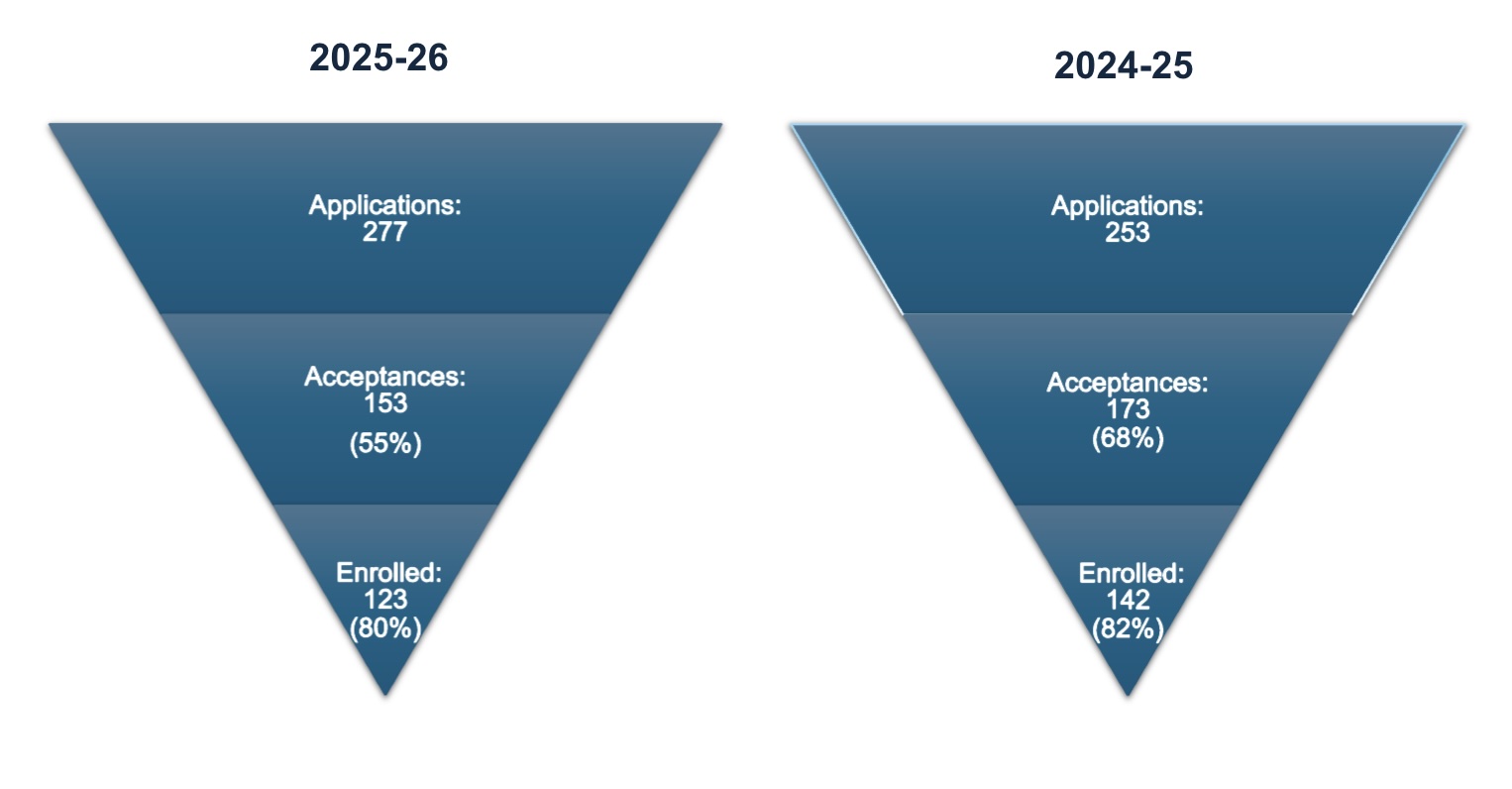
Admissions activity was strong. We received 277 completed applications, accepted 153 students, and enrolled 123—an 80% yield. Compared to ISACS benchmarks, we're slightly more selective than the 70% average acceptance rate and above the 77% average yield rate—performing better than average in both measures.
Looking ahead, the Board has established a goal for strategic enrollment growth leading to our 50th anniversary in 2032. This growth will be most notable in the upper school, where we're currently slightly smaller than optimal.
In Little Jags and PreK, we maintain sections of 14 to 16 students. From kindergarten through fourth grade, we keep sections at 18. We staff classrooms with both lead teachers and learning guides, and deploy additional specialists during math and reading to maintain a 7:1 ratio in those core subjects. In middle school, we offer four sections at each grade level, and try to maintain those around 16 students.
So, our goal is to reach 800 students while preserving our commitment to small class sizes. But I want to be clear in saying this growth will require adding classroom space, so you will hear from me momentarily on that. Next year, we anticipate similar enrollment to this year, and we're nearing capacity through eighth grade, so future growth will occur primarily in the upper school.
Philanthropy Overview
Like most independent schools, Wellington can count on the generosity of its community to support the school’s expenses beyond what tuition revenue covers. We are fortunate to have a committed parent and grandparent base, along with alumni, who recognize the importance of supporting the school through annual giving via the Wellington fund.
Make a gift to The Wellington Fund
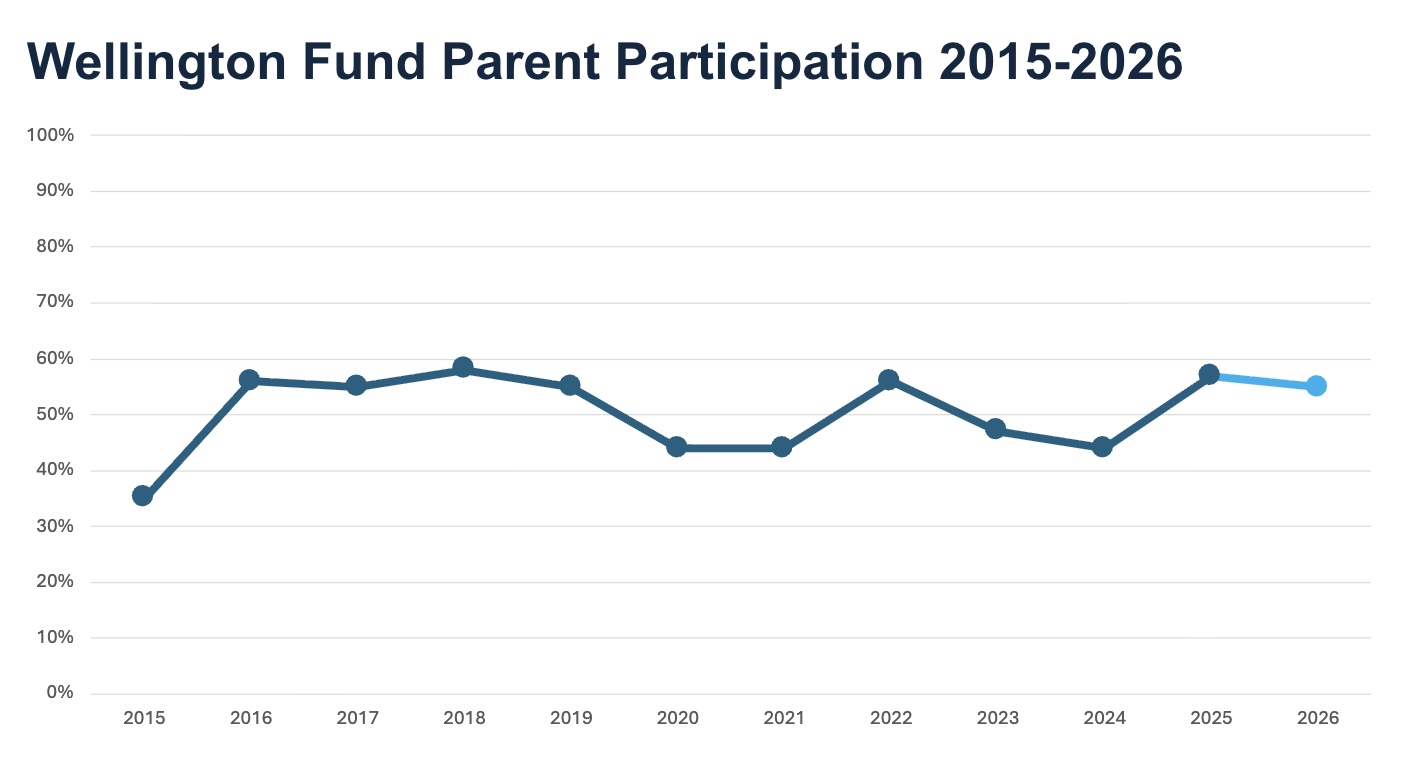
Looking back at the last ten years, our parent participation in the Wellington Fund has hovered around 50%. I see participation in the annual fund as one of the greatest indicators – beyond re-enrollment – of family satisfaction with the school and belief in our mission.
This year, parent participation is already 55%. That compares with last year at 57% overall which matched Wellington’s prior all-time highest participation. The fiscal year ends on June 30, so we have 4 months to go – I would love to see us set record participation this year.
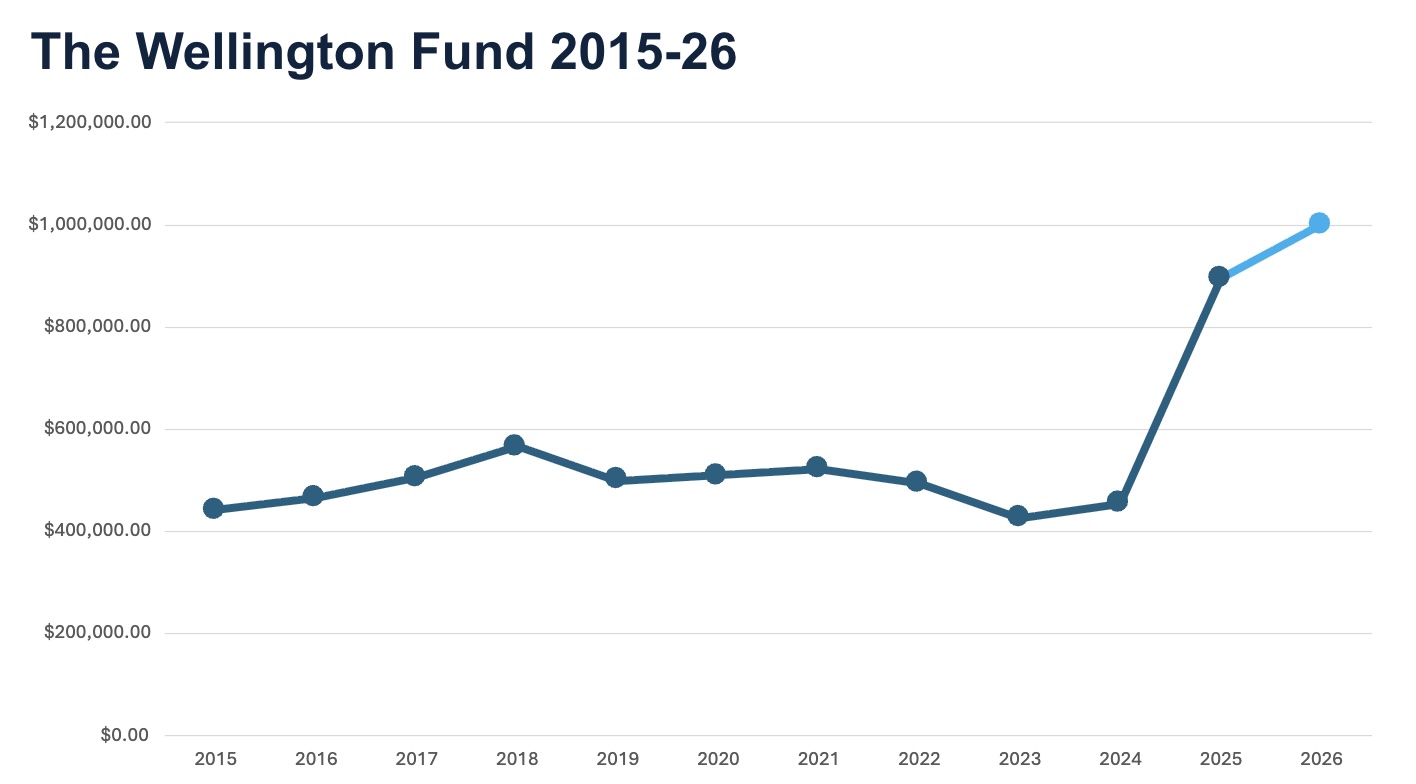
Last year, we raised a record-setting $896,211 for The Wellington Fund. Annual giving to The Wellington Fund includes unrestricted gifts, which we call “general mission support” and restricted gifts made to the 2024–25 funding priorities. We also received restricted gifts such as those mentioned earlier for professional development, planned gifts, and gifts to Wellington’s Scholarship Granting Organization (SGO).
Our total dollars raised thus far in 2026 fiscal year annual giving is already greater than the total we raised in the 2025 fiscal year. This does not include capital gifts which I’ll touch on in a moment. I am incredibly pleased to share that we have achieved our goal of $1 million in annual giving.
Strategic Plan
Last year, our trustees adopted a new strategic plan that charts our path to Wellington’s fiftieth year. As much as that plan points us forward, it is equally focused on protecting what must never change: our mission, our values, our commitment to innovative education, and the strength of our diverse and deeply connected community.
This video, released at the start of the year, expands on our strategic plan's commitments to people, place, and permanence.
Since launching the plan in the fall, we have been disciplined about aligning everything we do with its commitments. You see that discipline in the completion of the Croft Family Kindergarten Wing—delivered on time and under budget—in the academic and leadership updates I've shared tonight, in our enrollment and philanthropy progress, in our prioritization of faculty salaries and professional development, in our focus on academic excellence that prepares students for the world they are entering rather than the world of the past, and in the rapid progress of our campus master plan.
And that campus plan addresses very real challenges: academic space constraints in the Upper and Middle Schools, aging performing arts and visual arts facilities, and traffic flow and carline issues. There is also a significant imbalance—and a genuine opportunity—created by currently unusable and obsolete spaces on campus.
And we have an exciting plan to address it.
Campus Master Plan
We will maximize our existing footprint by taking down the original 1918 elementary school building—the one that is currently boarded up and visible from Fishinger Road. In its place, we will create a new Upper School entrance on Fishinger Road. This 3,000-square-foot entrance will serve as a community gathering space for Upper Schoolers during the day and as an event lobby for performances in this theatre.

The transformation of the Upper School learning environment will extend down the currently unused hallway outside, which will undergo a full renovation. In total, we will renovate or aesthetically update 66,000 square feet of interior space. By relocating the Upper School to the Fishinger Road side of the building, we will give students their own dedicated, state-of-the-art learning environment—one inspired by the spaces they are preparing to inhabit: collegiate halls, cafes, co-working spaces, engineering labs, and more. Upper School students and faculty will be able to park and enter on Fishinger Road, both giving them more space and easing pressure on the Reed Road entrance.
That move will allow us to expand the Middle School into more dedicated space of its own, taking over much of the current Upper School wing. We will also renovate our arts facilities—adding seats in the Blanchard Performing Arts Center and upgrading music and visual arts spaces—so they match the talent and creativity of our students.
These are smart, strategic investments that go where they matter most: our teachers and our students. And as I mentioned earlier, this campus plan allows us to meet essential facility needs without over-investing or significantly increasing our annual operating expenses.
We are eager to begin as soon as possible. We have been working closely with our architects at Moody Nolan, and the design is ready to go. We have partnered with Daimler Construction – special thanks to Trustee Tucker Bohm -- and secured extremely favorable pricing. At a moment when we could easily be imagining a $50 million project, we believe—and early estimates confirm—that all of this work can be completed in the range of $12 to $15 million, while delivering spaces that truly match the ambition of our program.
We are also working in strong partnership with the City of Upper Arlington and feel confident in our shared ability to move forward when the time is right. Our interests are well aligned: we all want the Fishinger Road façade to make a stronger impression and better reflect the Wellington School.
Early Campaign Enthusiasm
Perhaps most exciting is where we stand financially—because this community is already stepping forward. One of our founders, Ken Ackerman, has pledged a major gift toward this project. I can't express how much it means that our founders are behind this work. I've told them that part of our goal is to finally complete the buildout of the campus they purchased nearly fifty years ago, and their continued support tells me we are on the right path.
Twenty current Wellington families have joined Ken as early leaders of this project. Together, we have raised nearly $6 million in lead gifts toward the building campaign. We are already halfway to what we need—and that early enthusiasm gives us tremendous confidence in this community's readiness to rise to the moment.
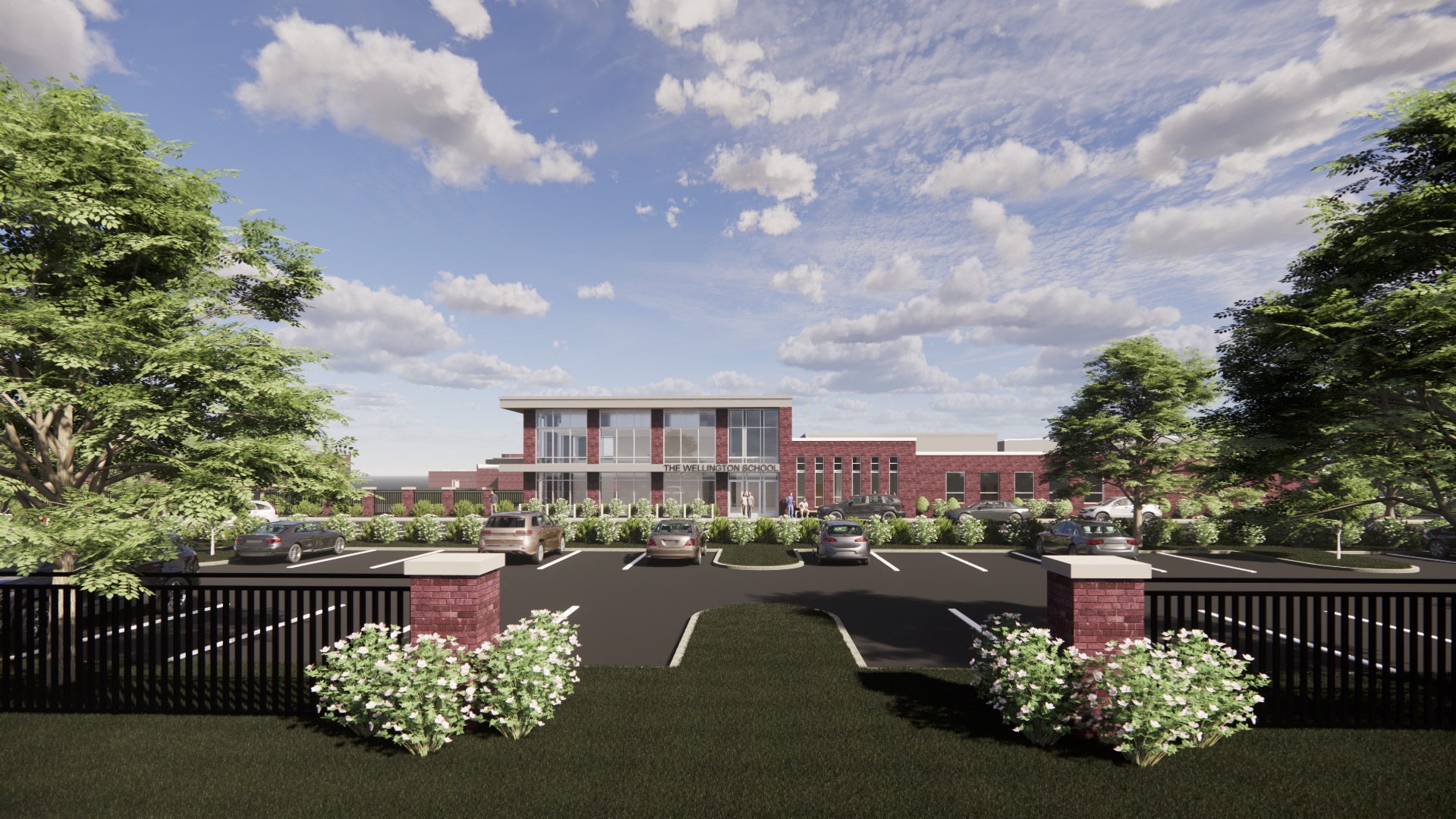
This project is ambitious, and will require the community’s investment; the result will be a campus that fully reflects who we are and who we are becoming—one that supports faculty excellence, inspires student learning, and completes the vision for Wellington's future. In the coming months, you will hear much more about timelines, opportunities to see the plans, and ways to get involved.
We have eight years in this strategic plan—but we are not waiting. Once we break ground, we anticipate roughly 18 months of construction, with many renovation improvements ready much sooner than that. My hope is to move as quickly as possible, while remaining disciplined and avoiding financial overextension. Campus construction is not funded by tuition dollars, and wise financial stewardship matters. We are making meaningful progress, together, with clarity, confidence, and purpose.
Gratitude
As we look to the rest of the 2025–26 academic year, I am deeply grateful for the partnership that defines this community. The months ahead will be shaped by the continued hard work of our students, supported by faculty and families who know them well. We extend our best wishes to the Class of 2026 and their families as they complete their Wellington student journey, and we look forward to welcoming them into our Jags Connect and Alumni communities.
Thank you for believing in this school. Thank you for investing in young people. Thank you for being part of a community.
Thank you for keeping the state of our school strong. Go Jags!